

“We’re Open For Business, Not Exploitation”
--Boakai Tells Investors

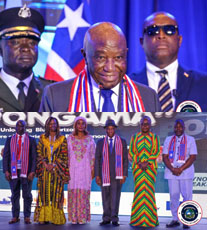
President Joseph Nyuma Boakai, , has officially launched the 10-Year National Fisheries Plan to mobilize investment and collective action.
The event is to develop fisheries sector to fully unlock its blue economy potential for national growth.
The initiative was launched in Margibi County on Monday, March 30, 2026, with theme: “Unlocking Blue Horizon; the Future of Fisheries and the Blue Economy.”
Pres. Boakai called on investors to invest in the fisheries sector, however sounding a caution that “Liberia is open for business, not exploitation. To those considering investment in fisheries, hear me clearly: we are open for business, but we are not open for exploitation. We seek partners, who will build local capacity, who will respect our environmental standards, and who will share the benefits with our communities.”
Boakai said, Liberia’s skilled waters are productive, and therefore, his Administration is committed to create an enabling environment through the new Public Private Partnership (PPP) strategy with streamlined regulations.
As a maritime nation, the launch of “the Blue Economy” will explore waters extending 200 nautical miles into the Atlantic Ocean, covering some of the richest fishing grounds in the Gulf of Guinea.
The country’s 570-kilometer coastline, with its estuaries, lagoons, and mangroves, serves as a nursery for over 254,000 metric tons of demersal species and approximately 94,000 metric tons of pelagic species.
The initiative, named and styled in the Kpelleh language, “Kpongama” (group gathering), directly supports the Government’s ARREST Agenda for Inclusive Development with a focus on job creation, economic empowerment, and accountability.
It is also aligned with the African Union Blue Economy Strategy, the ECOWAS Fisheries Policy Framework, and Sustainable Development Goal 14; Life Below Water.
Through the efforts, Liberia is positioning itself not as a bystander, but as a regional leader in the blue economy.
Pres. Boakai said, Liberia possesses 579 kilometers of coastline and 200 Exclusive Economic Zone (EEZ) rich in marine life; yet imports more than 33,000 metric tons of fish annually.
“Liberia’s catch of very high value species is landed in foreign ports, because of its lack of a dedicated fishing harbor.”
Boakai said, the artisanal fisher, which provides about 80 percent of the domestic fish production operates without adequate cold storage, without digital payment systems, and too often, without the dignity their labor deserves, a condition his Administration has for now lived with.
Boakai: “This is not a situation we accept. It is a challenge we embrace.”
He served as the chief-launcher.
“When my Administration took over the affairs of the State, NaFAA moved away from reliance on industrial vessel licensing fees to private-sector-driven growth.”
Pres. Boakai recalled: “When I took office, I directed my Government to move NaFAA away from just over-reliance on industrial vessel licensing fees to a model that served bureaucracy more than it served our people. We are pivoting toward private-sector-driven growth through public-private partnerships, and value-chain development that keeps jobs and revenue here in Liberia and increases our foreign direct earnings.”
Boakai said, his Administration has secured a €25 million grant from the European Union to enhance the artisanal fisheries value chain and that the government has partnered with Orange Liberia to introduce mobile-based solutions and solar-powered cold storage that will reduce post-harvest losses.

Comments are closed.