

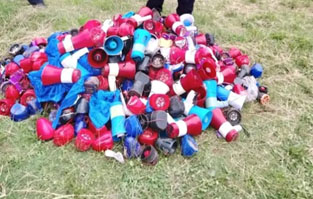

Gbarnga has increasingly become a city where noise have no limits to the extent that in some communities, the situation is no longer uncontrolled.
This has raised questions about the effectiveness of government institutions responsible to protect the public from environmental disturbances.
Across several parts of the city, residents are being regularly exposed to loud music, vehicle horns, motorcycle noise, commercial announcements, and the continuous use of megaphones by businesses, religious groups, street vendors, and other organizations.
For residents, the problem is not simply about inconvenience. They say, the persistent noise has become a public nuisance that demands stronger attention from authorities responsible for environmental protection, and city regulation.
Despite repeated concerns from communities, residents question why excessive noise continues in busy commercial, and residential areas without “sufficient enforcement?”
The situation has placed spotlight on the Environmental Protection Agency (EPA), and other government institutions with responsibilities related to environmental standards, and public welfare.
Critics argue that environmental protection should not focus only on issues of waste, pollution, and natural resources while disturbances caused by excessive noise receive limited attention.
They meanwhile, want the government to demonstrate that environmental regulations are enforced beyond Monrovia, and other major centers, including growing cities such as Gbarnga.
The widespread use of megaphones has become particularly noticeable in the noise pollution.
Mobile vendors, event promoters, religious groups, and other public announcers are often heard using amplified sound in crowded areas, sometimes closed to homes, schools, offices, and other sensitive locations.
Residents say, authorities should establish clear, and enforceable standards governing when, where, and how loudspeakers, and megaphones are used.
They have also questioned the role of the Gbarnga City Corporation, and other local authorities in controlling activities that contribute to “excessive noise.”
