
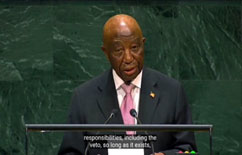

Liberia’s President Joseph Nyuma Boakai has delivered one of the most pointed interventions at the United Nations in years, demanding Africa’s place at the Global decision-making table. He also challenged the international system to confront what he described as deep inequalities, selective application of global rules and Africa’s exclusion from permanent decision-making power.
Addressing world leaders at the 81st United Nations General Assembly in New York on Thursday, President Boakai argued that the crisis confronting multilateralism is not proof that international cooperation has failed, but evidence that the institutions governing it must change. “Our answer to that fragmentation cannot be less multilateralism. It must be better multilateralism,” Boakai declared.
His speech placed Liberia at the center of several of the most consequential debates confronting the international community, from wars and humanitarian crises to global finance, climate justice, artificial intelligence and youth unemployment. But the sharpest demand was directed at the structure of the UN Security Council. The Liberian leader called Africa’s exclusion from permanent membership of the Council a “historic injustice,” arguing that a continent that accounts for a substantial share of UN membership and much of the Council’s peace-and-security agenda cannot remain largely absent from the institution that makes binding decisions on those issues.
He continued: “Correcting this imbalance is not a favour to Africa.” Liberia reaffirmed support for the Common African Position calling for at least two permanent African seats on the Security Council, with the rights and responsibilities attached to permanent membership, including veto rights for as long as the veto remains part of the Council’s structure. The demand carries weight because Liberia is currently serving as an elected member of the Security Council for the 2026–2027 term, giving Monrovia a direct seat inside the institution whose structure it is calling to reform.
The Liberian President argument went beyond the question of African representation; rather questioning the credibility of the United Nations of being weakened by a perception that international rules and principles are applied inconsistently. For Liberia, the issue carries historical significance. The President reminded delegates that Liberia was among the African countries that signed the UN Charter in San Francisco in 1945. More than eight decades later, he presented Liberia’s own transition from civil war to constitutional democracy as evidence that societies can rebuild when political actors commit themselves to dialogue, accountability and institutional reform.
the Liberian President also used Liberia’s experience to make a broader argument: “peace cannot be separated from development, and development cannot be sustained without peace.” He called for an immediate end to hostilities in conflict zones, humanitarian access for civilians and respect for international humanitarian law, warning that ordinary people continue to bear the consequences of wars they did not create.
As a current Security Council member, Liberia is seeking to position its post-war experience as part of the international conversation on conflict prevention, peacebuilding and institutional recovery. The Liberian President also turned his attention to the international financial system, arguing that developing countries are operating under increasing pressure from debt, restricted fiscal space and recurring external shocks. He called for reforms that would expand access to concessional financing, strengthen debt sustainability and provide more predictable development capital.
However, he reserved some of his strongest criticism for the governance structures of the World Bank and International Monetary Fund. According to him, institutions created in the aftermath of World War II no longer adequately reflect contemporary population and economic realities.
“A financial system that decides the fate of billions cannot continue to be governed by so few,” he said.
For Liberia and other developing countries, the dispute is not merely about representation. The cost and availability of international financing can directly affect governments’ capacity to build roads, expand electricity, improve schools and hospitals, support agriculture and create employment. President Boakai therefore linked reform of global financial institutions to the implementation of the UN Sustainable Development Goals.
Boakai highlighted the disparity between Liberia’s relatively small contribution to global greenhouse-gas emissions and the climate-related pressures facing Liberian communities, including coastal erosion, flooding and disruptions to agricultural production. He also pointed to Liberia’s role in protecting the Upper Guinean Rainforest, describing the country’s forests as an important global carbon sink.
Therefore, the President’s argument was straightforward: countries that provide environmental benefits to the global community should not be left to shoulder the economic cost of protecting those resources alone. He called on industrialized countries to honor climate-financing commitments and operationalize mechanisms addressing loss and damage. The position fits into Liberia’s wider effort during the UN General Assembly to place climate, natural resources, peace and development within the same policy conversation.
President Boakai also used his address to press for greater investment in Africa’s young population. He contended that Africa’s demographic structure could become a major source of innovation and economic growth if governments invest aggressively in STEM education, digital literacy and technical and vocational training. Without those investments, he warned, Africa risks becoming primarily a consumer rather than a producer of the technologies transforming the global economy. That concern also extended to artificial intelligence, adding that Liberia backed stronger international governance of emerging technologies, including ethical standards and safeguards around the use

Comments are closed.