


Government has conducted its first quarterly review of the Mission-300 Energy Compact, reporting progress in expanding electricity access throughout the country.
It acknowledges major policy, financing, and implementation challenges continue to slow the energy reform agenda.
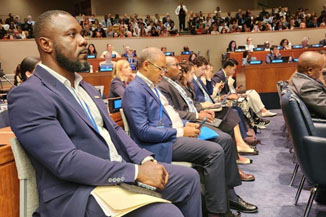
The high-level steering committee meeting, held at the Ministry of Mines and Energy in Monrovia, brought together representatives from the Compact Delivery and Monitoring Unit (CDMU).
The Liberia Electricity Corporation (LEC), the Liberia Electricity Regulatory Commission (LERC), the Rural and Renewable Energy Agency (RREA), and other technical institutions responsible for implementing the compact.
Mines and Energy Minister, Richard Matenkay Tingban, described the steering committee as government’s principal oversight body for the Mission-300 initiative.
Tingban said, the meeting marked the first formal assessment of the implementation efforts.
He called for stronger coordination among government institutions to address persistent electricity challenges.
The Compact Delivery and Monitoring Unit, headed by Program Manager Kelvin K. Grugbaye, presented its 2025 implementation report, outlining Liberia’s commitments under the Mission-300 Energy Compact.
In the report, Liberia has undertaken 24 policy and program actions to strengthen the energy sector through renewable energy expansion, increased electricity access, promotion of clean cooking, regional power integration and greater private sector investment.
Officials reported that approximately half of the planned activities are currently under implementation, while only eight percent have been fully completed.
The report highlighted several achievements, including renewable energy generation reaching 86 percent surpassing the national target and about 80 percent of the annual objective of connecting 100,000 new households to electricity being achieved during 2025.
LEC also reported improvements in revenue collection, intensified efforts to combat electricity theft, and measures to improve financial transparency.
Authorities further disclosed that Liberia is expected to commission its first Independent Power Producer (IPP) projects in 2026, a move expected to increase private investment in electricity generation and reduce the dependence on government-funded power infrastructure.
Despite these gains, the Committee acknowledged obstacles that continue to undermine implementation.
At the close of the meeting, members of the Committee adopted series of resolutions, and reaffirmed commitment to hold quarterly review sessions to monitor implementation, address emerging challenges, and accelerate delivery of the Mission-300 Energy Compact.
Deputy Minister for Energy Charles Umehai, thanked participating institutions for their collaboration, and pledged the Ministry’s continued oversight to expand electricity access to all parts of the country.

Comments are closed.