

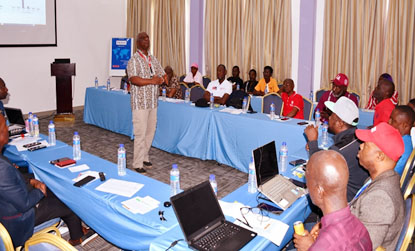

The Liberia Revenue Authority (LRA), one of the principle arms of taxation of the Liberian Government has provided training for editors and talk show hosts of media entities in Liberia.
For two days,( 3-4, September 2025), the LRA took the media professionals to the Farmington Hotel in Margibi County to be trained under the theme: Enhancing Tax Awareness & Public Engagement Through The Media.
The Commissioner General of the Liberia Revenue Authority, Dorbor Jallah, said the work of the LRA is central to building a better Liberia.
He said revenue collection is the lifeblood of government, funding schools, hospitals, roads, and the many services that citizens rely upon.
Yet, Mr. Jallah noted that this mission cannot succeed without the trust and understanding of the Liberian people. “This is where your role as media practitioners is indispensable. You are the bridge between the LRA and the public. Through your platforms—whether on the airwaves, in print, or online—you inform, educate, and shape public opinion,” CG Jallah indicated.
According to him, accurate reporting on the tax system empowers citizens to comply voluntarily, fosters a culture of patriotism, and ensures that every Liberian understands that paying taxes is not a burden, but a contribution to national development. He said the LRA has entered a bold new phase of transformative reforms.
Some of the reforms which CG Jallah said demand understanding, adaptation, and acceptance from the public include, the transition from Goods and Services Tax (GST) to Value Added Tax (VAT) by 2027, a comprehensive Real Property Tax reform—using digital mapping and working with local governments to expand collection, an expanded Excise Tax regime and new measures to bring the informal sector into the tax net, and the digital transformation of tax administration, amongst others.
“That is why we have brought you in. You are the voice of the people. You set the conversations in communities.
You explain policies, you question inconsistencies, and you influence public behavior. That is why this partnership matters.
When you report accurately on tax and revenue, you don’t just inform—you help build transparency, trust, and national ownership.
You help improve compliance. And when compliance improves, government can do more: more schools, better roads, stronger health services, and timely salaries for public servants. This training is part of a longer journey—one we intend to take across the country as resources allow. Our vision is that every journalist in Liberia will one day understand how the LRA works and be confident in reporting on tax and revenue matters,” CG Jallah told the media professionals.
As Commissioner General, Jallah said he wants to make this clear: “this is just the beginning. At the same time, we are aware of the challenges we face. In an era where misinformation, disinformation, and negative propaganda can spread quickly, the media becomes not just a messenger, but a guardian of truth.”
He continued: “Together, we can counter falsehoods with facts, suspicion with clarity, and mistrust with transparency. This workshop is therefore about partnership. The LRA commits to opening its doors wider, sharing accurate information, and making tax administration clearer and more accessible.”
CG Jallah further said the LRA counts on the media to use their voices responsibly to promote awareness, fairness, and compliance.
“Let us leave here united in a common vision: a Liberia where tax education is widespread, where citizens embrace their duty to pay taxes voluntarily, and where revenue mobilization becomes a proud national endeavor,” he noted.
“The Information Gap Theory warns us that when citizens lack access to credible information, they make poor choices. Taxation is already a complex subject; when gaps remain, myths and misconceptions fill the space,” Danicius Kaihenneh Sengbeh,
Manager, Communications, Media & Public Affairs (CMPA), LRA said in the opening statement.
According to him, “the Agenda-Setting Theory reminds us that you, the media, decide what issues rise to the top of national discussion. If taxation is framed as a burden, people will resist. If it is framed as a civic duty for development, people will embrace it.”
He continued: “The Gatekeeping and Framing Theories tell us that how you choose stories, what angles you emphasize, and what language you use, all shape how the public perceives an institution like the LRA. One headline or sound bite can either build confidence or sow distrust.”
“These theories,” he noted, “prove one thing: if taxation is not properly explained, prioritized, and framed by the media, Liberia risks losing billions or not reaching billions in revenue needed for schools, hospitals, and roads. That is why the LRA must not only engage you but partner with you.”
The Communication Manager said: “The two-day workshop is therefore more than training—it is a strategic investment. Pre-training surveys with over 30 journalists revealed gaps in understanding core tax concepts, LRA processes, and innovations. Together, we will bridge those gaps. You are not here to be PR officers for the LRA—that would undermine your independence. You are here to be empowered as Tax Ambassadors—trusted voices who can interpret, analyze, and explain taxation for the good of the people.”

Comments are closed.