

Rumors had surfaced in Monrovia accusing authorities at the Liberia Drug Enforcement Agency (LDEA) of refusing to yield to pressure.
The pressure, reports said, is mounted on the heads of the Agency to name people they referred to as “persons-of-interest” in the recent captured of cocaine.
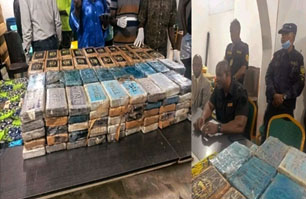
LDEA agents intercepted the cocaine with street value of L$3.6 Billion or US$19.2 million, on Monday, June 8, at the Robert International Airport, Lower Margibi County.
In the wake of the controversies, which surrounded arrest of the illegal drug, a female Bong County District #6 Representative, Moima Briggs-Mensah, has strongly criticized LDEA for “delaying to name or identify suspected individual(s) connected to the busted drug.”
Rep. Mensah wants the names of individuals linked to the drug.
She spoke during deliberations on Capitol Hill at the House on Thursday, June 11.
Rep. Mensah described the Agency’s handling of the “sensitive matter as deceptive.”
Rep. Mensah also wants the indulgence of her colleagues to invite officials of the LDEA, and other state security agencies to appear before the House for questioning. She argued that Liberians deserve timely information on a case of such magnitude, given its implications for the fight against narcotics trafficking. “Withholding key details from the public risks undermining confidence in the investigation and the government’s anti-drug efforts.”
Henceforth, LDEA Officer-in-Charge, Fitzgerald T.M. Biago, has appealed for more time to properly investigate the case free from coercion.
He told a press conference that the seizure of the US$19 million drug, is a “transnational crime, which required extensive and thorough investigation.”
Biago confirmed that already, the Agency has identified six persons-of-interest, who are currently in LDEA custody and under investigation.
He however declined to disclose their identities. Biago cited security concerns and the need to protect the integrity of the investigation.
The discovery has intensified concerns about the activities of international drug trafficking networks operating across West Africa. It has also raised questions about how such a large quantity of cocaine was able to reach the principal international gateway, then destined for European market. The case has also reignited public debate over the effectiveness of border security measures, cargo screening procedures, and airport monitoring systems.
Analysts have warned that international drug cartels continue to employ increasingly sophisticated methods to evade detection and exploit weaknesses in regional transportation networks.
Despite declining to reveal the identities of the suspects or details concerning the origin and intended destination of the shipment, Biago assured the public that the investigation remains “active and comprehensive.”
Wilmot Konah contributed to the story.

Comments are closed.