

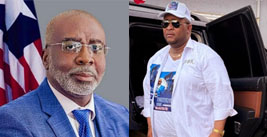
Koffa, Kamara Granted Medical Leave
-Amid Inconclusive Capitol Arson Trial

Criminal Court “A” Judge Roosevelt Z. Willie at the Temple of Justice has granted temporary medical travel clearance to two lawmakers, embroiled in the ongoing Capitol Building Arson case, allowing them to seek treatment abroad while their criminal trial remains stalled before the Supreme Court.
In separate rulings, the court approved applications filed by the legal teams of former House Speaker Cllr. J. Fonati Koffa and Montserrado County District Number 15 Representative Abu Bana Kamara, temporarily lifting travel restrictions imposed, as part of the conditions governing their release on criminal appearance bonds.
According to official court orders signed by the Clerk of Court Hector M. Dolo, Cllr. Koffa has been authorized to travel to the United States from June 15 through July 18, for medical examinations and health consultations.
Representative Kamara was similarly granted permission to seek specialized medical treatment abroad after reports that his health deteriorated following his detention last year.
Sources close to the defense say,Kamara experienced severe spikes in blood pressure during his incarceration at the Monrovia Central Prison, commonly known as South Beach, prompting concerns among family members and medical practitioners about his long-term health.
The court’s approval comes against the backdrop of one of Liberia’s most politically charged criminal cases in recent years, a prosecution that has deepened tensions between the Unity Party-led government and the opposition Congress for Democratic Change.
A Case That Shook the Legislature
The criminal proceedings stem from the devastating fire that engulfed the Joint Chambers of the Capitol Building on December 18, 2024, causing extensive destruction.
The blaze occurred during a period of intense political turmoil within the House of Representatives, where a self-declared “Majority Bloc” of lawmakers was aggressively pursuing efforts to remove Cllr. Koffa from the Speakership amid an escalating leadership crisis.
Images of the burning legislative chambers shocked the nation and sparked widespread demands for accountability.
The incident also intensified partisan divisions, with political observers warning that the destruction threatened public confidence in Liberia’s democratic institutions.
Following months of investigation, the Liberia National Police announced that the fire was not accidental.
Investigators concluded that the incident was allegedly a coordinated and politically motivated act intended to destabilize the Legislature.
Authorities estimated damages to the Capitol Building at more than US$1.8 million.
The police findings eventually led prosecutors to pursue charges against several senior opposition lawmakers, including Koffa, Kamara, Montserrado County District Number 16 Representative Dixon Seboe, and Grand Gedeh County Representative Jacob Debee.
Arrests, Indictments and Denials
In June 2025, the four lawmakers were arrested and detained at South Beach Prison before securing their release through a joint criminal appearance bond valued at approximately US$440,000.
Months later, a Montserrado County Grand Jury returned an indictment formally charging the lawmakers with multiple offenses, including arson, criminal mischief, theft of property, criminal conspiracy, and terroristic threats.
The accused lawmakers have consistently rejected all allegations, describing the prosecution as politically motivated and lacking credible evidence.
Defense attorneys have repeatedly argued that the government’s case relies heavily on questionable digital evidence and circumstantial claims that fail to directly connect the lawmakers to the destruction of the Capitol Building.
At their arraignment before Criminal Court “A,” all defendants entered pleas of not guilty.
Supreme Court Intervention Freezes Trial
Despite the seriousness of the charges, the anticipated trial has yet to commence in earnest.
Proceedings remain frozen after the defense successfully petitioned the Supreme Court of Liberia to review several contentious legal issues arising from the case.
Among the concerns raised by defense lawyers are questions surrounding legislative immunity, constitutional due process protections, and the admissibility of evidence presented during preliminary hearings.
The Supreme Court’s Chamber Justice subsequently ordered Criminal Court “A” to halt all proceedings pending review by the full bench.
That stay order has prevented prosecutors from moving forward with trial preparations while the country’s highest court considers arguments that could significantly affect the future of the case.
Legal analysts say the Supreme Court’s eventual ruling could establish important precedents concerning the prosecution of sitting lawmakers and the standards required for the admission of digital evidence in criminal proceedings.
Balancing Justice and Health Concerns
The latest court decision reflects what legal observers describe as an effort to balance the constitutional rights of the accused with the state’s interest in ensuring their availability for future proceedings.
While granting the temporary travel requests, Criminal Court “A” emphasized that both lawmakers remain under the jurisdiction of the Liberian courts and are expected to return immediately upon the expiration of their medical leave.
Neither the prosecution nor defense teams have publicly indicated whether additional defendants in the case may seek similar travel permissions.
Meanwhile, the Capitol arson case remains in legal limbo, its principal defendants temporarily leaving the country for medical reasons while the nation awaits a potentially landmark Supreme Court ruling that could determine whether one of Liberia’s most controversial criminal prosecutions proceeds to trial or faces constitutional hurdles.
As the judicial process unfolds, the fire that once reduced part of the Capitol Building to ashes continues to cast a long shadow over Liberia’s political landscape, serving as a stark reminder of the deep divisions that have defined the country’s post-election political environment.

Comments are closed.