

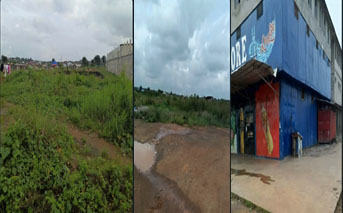

The Sixth Judicial Circuit, Civil Law Court at the Temple of Justice has ordered a full trial concerning 5.58 acres of beachfront land within the historic Hotel Africa Compound, outside Monrovia.
The dispute involves the Government of Liberia and businessman Nelson Oniyama. Presiding Judge, His Honor Nelson B. Chineh, denied the Government of Liberia’s Motion for Cancellation, which sought the summary voiding of the Development Grant Deed held by Dr. Oniyama for the Seaview Golf Course.
The ruling, delivered on Thursday, July 30, 2026, marks the first significant judicial challenge to the Boakai administration’s sweeping campaign to reclaim what it deems illegally acquired public lands, with Hotel Africa and its surrounding areas as a focal point.
The Government’s Case: Void Ab Initio The State, represented by the General Services Agency (GSA) and the Ministry of Justice, petitioned the court to cancel the deed based on several arguments rooted in public land law.
The deed was signed solely by former Liberia Land Authority (LLA) Chairman Atty. Adams Manobah, without the necessary resolution or authorization from the LLA Board of Commissioners, as required by the LLA Act.
The grant violated Article 55(b) & (c) of the Land Rights Regulations and the Public Procurement and Concessions Act (PPCA), as public land was conveyed without competitive bidding or public notice.
There was no evidence of payment of the grant fee into government revenue. On these grounds, the State contended that the deed was not merely voidable but void ab initio—illegal from the outset—and therefore subject to cancellation without a full evidentiary trial.
The Defense: Bona Fide Purchaser and Presumption of Regularity Counsel for Seaview Golf Course presented a classic property law defense. The defense argued that Dr. Oniyama is a bona fide purchaser for value without notice.
He negotiated with the statutory authority responsible for managing public land, paid valuable consideration, obtained a Development Grant Deed under the seal of the LLA, and solidified his title by probating and registering it with the Center for National Documents and Records Agency (CNDRA).
Under Liberian law, a registered and probated deed carries a strong presumption of regularity and validity. The defense contended that any internal procedural lapses within the LLA—such as the failure to obtain board minutes, conduct a bidding process, or remit funds—are attributable to the grantor, not the grantee.
Such lapses cannot, without more, divest a citizen of a vested property right without due process of law as outlined in Article 20(a) of the 1986 Constitution. To cancel such a deed, the State must do more than allege irregularities; it must provide proof.
The Court’s Ruling: Both Sides Wanted Too Much, Too Fast Judge Chineh found that both parties had invited the court into procedural error
The court faced two diametrically opposed dispositive motions: the Government’s Motion for Cancellation seeking summary voiding and the Respondent’s Motion for Judicial Review seeking summary affirmation of the deed. The court denied both motions.
Citing the controlling Supreme Court precedent in Saleh v. Liberia Trading Company, Judge Chineh ruled that once a deed is probated and registered, it confers a legal interest that cannot be extinguished by mere motion supported by affidavit.
When the State alleges significant vitiating factors such as fraud, lack of authority, illegality, and failure of consideration—precisely the allegations made against the Seaview deed—the law requires proof by clear and convincing evidence.
Judge Chineh determined that such proof can only be established through a plenary trial, involving live witnesses, properly authenticated documentary evidence, and cross-examination.
“A court cannot cancel a registered deed on allegations,” Judge Chineh stated in the court minutes. “Allegations must be transmuted into proof.
” The Judge also rejected Seaview’s request to declare the deed valid on the documents alone, emphasizing that when the State has significantly challenged the legality of the grant process, the court cannot simply endorse the instrument.
The State is entitled to its day in court to substantiate its claims of illegality. What Happens Next According to court minutes, State lawyers indicated their readiness to proceed to a full trial if summary relief was denied. Counsel for Dr. Oniyama did not object, expressing confidence that a trial on the merits would vindicate his client and demonstrate that all legal requirements were met at the time of purchase.
Judge Chineh has now converted the matter to a full trial on the merits, ordering both parties to file their Pretrial Memoranda within ten (10) days. This sets the stage for a legal battle involving witness testimonies, LLA records, and payment receipts.
For the Government, this signals that the recovery of public lands will not be a shortcut administrative process. Courts will require strict proof of wrongdoing, not merely allegations of regulatory non-compliance.
For property owners and investors, the ruling is a strong reaffirmation of the sanctity of registered titles in Liberia. The message from the Civil Law Court is clear: in Liberia, a deed registered at CNDRA protects the holder until the government proves otherwise in an open court, under oath—not through press releases or motions.
The fate of the 5.58 acres will not hinge on technicalities; it will be determined through witness testimony.

Comments are closed.