
Gbeisay’s Proposal Resisted
By Abraham K. Morris and Domingo Dargbe

Chief Justice Yamie Quiqui Gbeisay’s proposal to abolish jury trials has sparked growing opposition from senators, and some members of the Liberia National Bar Association (LNBA).
The opposition favor reforms that would address jury tampering as well as protect constitutional rights.
At the opening of the Supreme Court October Term, Chief Justice Gbeisay cited jury manipulation in several counties.
He warned that corruption threatens public confidence in the justice system.
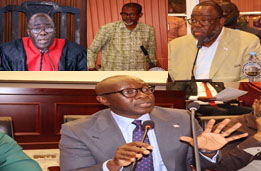
However, Montserrado County Senators, Abraham Darius Dillon, Gbarpolu County Senator, Amara Mohammed Konneh, Margibi County Senator, Nathaniel Farlo McGill, and Bomi County Senator, Edwin Melvin Snowe, Jr. have resisted the call.
They meanwhile, called for stronger safeguards rather than outright abolition.
They argued that jury tampering should be addressed through stricter enforcement, transparent jury selection, improved juror protection and compensation, and prosecution of proven misconduct.
Dillon maintains that eliminating constitutionally protected jury trials would require careful adherence to the constitutional amendment process, while Konneh warns that abolishing juries would not necessarily eliminate corruption within the judiciary.
The LNBA, through its President, Juah Lawson, has condemned jury tampering, but clarified that its willingness to discuss the proposal does not amount to support for abolition.
The Association favors examining weaknesses in jury management, security and enforcement before considering fundamental changes.
The debate centers on Articles 20(a) and 21(h) of the 1986 Constitution, which address due process, and the right to trial by jury in covered criminal cases. Any proposed changes must be assessed against the constitution’s applicable amendment requirements.
Reform advocates have also called for a review of the Office of Jury Management, established through legislative reform in 2013, alongside public hearings involving the judiciary, legislature, legal practitioners and members of civil society.
Ultimately, the debate extends beyond whether juries should remain. It raises fundamental questions about judicial accountability, constitutional rights, and the public’s confidence in a justice system where verdicts must be determined by evidence and law; not money, intimidation or influence.
Dillon Cites Constitutional Safeguards
For Dillon, he strongly opposed the proposal.
He informed Gbeisay that the practice is a fundamental constitutional right that cannot be eliminated through ordinary legislative action.
In a statement published on his Facebook, Dillon referenced Article 20(a) of the 1986 Constitution, which guarantees the right to trial by jury. He said, any attempt to abolish the practice would require a national referendum.
Dillion said, the constitution explicitly states that parties “shall have the right to trial by jury,” but to make the provision a fundamental safeguard that should not be removed without following the appropriate constitutional process.
He also challenged the justification for the proposed abolition. Dillion argued further that concerns about jury-tampering do not provide sufficient grounds to eliminate the constitutional guarantee.
He said, report of jury-tampering exposes weaknesses within the justice system, and raises questions about the judiciary ability to enforce existing laws, and punish those found culpable of a crime.
“We cannot simply seek to undo laws, because of our failure to summon the courage to implement, and enforce the laws.”
To illustrate his position, Dillion compared abolishing jury trials, because of jury-tampering to burning down an entire house to eliminate a troublesome rat.
He argued that authorities should instead address the specific problem without destroying the system.
Dillion emphasized the need to strengthen law enforcement, and ensure accountability as an appropriate response to jury-tampering allegations rather than eliminate trial by jury altogether.
