

Govt Buildings Threatened By Costal Erosion In Harper
By: Aaron B. Nemah

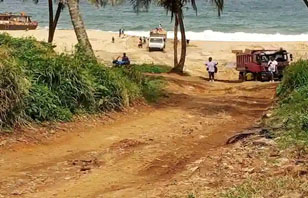
Harper City, the capital of Maryland County, is facing a growing environmental crisis as coastal erosion and unregulated beach sand mining push the Atlantic Ocean dangerously close to major public institutions and historic infrastructure.
Residents said if urgent action is not taken, the county could lose some of its most important public facilities to the advancing sea.
Among the institutions reportedly threatened by the advancing ocean are Cape Palmas High School, the largest public high school in Maryland County, the Maryland County Administration Building, the central police station, and the historic Harper Museum, particularly in the Printing Street area.
The coastal stretch that once hosted the popular Miami Beach entertainment center has already been completely washed away – a clear sign of how fast the coastline is disappearing, according to residents.
Locals fear that Cape Palmas High School, which hosts hundreds of students, and the County Administration Building, the seat of local government, could be the next victims if erosion continues unchecked.
Robert Harold Clark Jr., a longtime resident of Harper, blames the crisis partly on years of persistent sand mining along the Harper beach by the Harper City Corporation and private residents.
Clark accused the Environmental Protection Agency (EPA) of failing to enforce environmental regulations, allowing illegal and unregulated extraction of beach sand to continue despite its devastating impact on the coastline.
He pointed to the disappearance of Miami Beach as living evidence that sand mining has weakened the natural coastal defense and accelerated erosion.
”The sea is eating up Harper. We mined the sand for years and now there is no protection.
The EPA is not doing enough,” Clark lamented.
Responding to the concerns, EPA representative in Maryland County, James Pody, admitted the seriousness of the situation but said the county lacks accessible alternative sites for sand mining.
Pody disclosed that environmental assessments had earlier identified potential alternative mining sites in Whole Graway and Grand Cavalla, but poor road conditions have prevented the relocation of miners from the Harper beach.
He said the EPA is planning to engage county authorities and partners to rehabilitate access roads to the identified sites, which could allow the closure of the existing beach-mining site in Harper.
However, Pody did not provide a definite timeline for the closure, raising concerns that more damage could occur before action is taken.
With the Atlantic Ocean now visibly close to critical public infrastructure, environmentalists and residents are calling on the Government of Liberia, through the Ministry of Mines and Energy, EPA, and the Maryland County Administration, to act swiftly to protect Harper’s coastline.
They have recommended Immediate ban on beach sand mining in Harper, Construction of a sea wall or revetment along the threatened coastline, Rehabilitation of roads to alternative mining sites in Whole Graway and Grand Cavalla and Community awareness on coastal protection.
For now, the people of Harper watch with anxiety as the ocean advances, hoping that authorities will intervene before Cape Palmas High School, the County Administration Building, and other historic landmarks become history like Miami Beach.
