

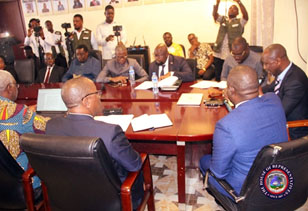

The House of Representatives Joint Committee on Ways, Means, Finance and Budget, and Public Accounts, on Monday, November 23, commenced public hearings into the revenue component of the proposed US$1.54 billion Fiscal Year 2027 national budget.
The process involves the Ministry of Finance and Development Planning (MFDP), and the Liberia Revenue Authority (LRA) appearing before the Committee.
The hearings are to scrutinize the credibility, feasibility, and sustainability of revenue projections, assess current revenue performance, and examine measures to strengthen domestic revenue mobilization in support of national development priorities.
At the start of the hearing, Joint Committee Chairman, P. Mike Jurry, stressed the need for realistic revenue projections, effective tax administration, accountability, and fairness in the revenue system.
Jurry noted how development financing must increasingly depend on a predictable, and sustainable domestic revenue base rather than external assistance.
He also spoke of the importance of the tax base, improve compliance, reduce revenue leakages, strengthen customs administration, address tax exemptions, formalize economic activities, and leverage technology to improve revenue collection.
He also called for proper assessment, and accountability of revenues generated from natural resources, public institutions, and state-owned enterprises.
While presenting the revenue outlook, Deputy Finance Minister for Fiscal Affairs, Anthony G. Myers, disclosed how the proposed FY2027 budget stands at US$1.539 billion, representing an 11.5 percent increase over the projected FY2026 outturn of US$1.380 billion.
Myers said, domestic revenue is projected to account for approximately 94 percent of the proposed budget’s resources, with tax revenue expected to exceed US$1 billion for the first time, reaching US$1.072 billion.
He explained how the FY2027 revenue forecast is largely based on recurring revenue sources rather than one-off receipts, including signature bonuses, with projections supported by growth in trade, services, agriculture, and other economic sectors.
He said, key policy measures underpinning the forecast include the implementation of a 15 percent Value Added Tax (VAT) beginning January 1, 2027, replacing the existing Goods and Services Tax (GST); a 2 percent advance corporate income tax on turnover for mining and agriculture companies; strengthened tax compliance, and customs enforcement; electronic tax invoicing; and proposed amendments to the tax laws.
Myers also assured lawmakers that rice, and petroleum products will remain outside the VAT regime, while acknowledging potential challenges associated with VAT implementation, commodity price fluctuations, mining output, and external resource disbursements.
Liberia Revenue Authority Commissioner General, James Dorbor Jallah, reported that the Authority had collected US$1.260 billion in total revenue as of November 21, 2026, representing approximately 97 percent of the approved annual revenue target.
He said domestic revenue collection had reached US$1.181 billion, surpassing the full-year domestic revenue target, while Customs had achieved 105 percent of its annual target and the Domestic Tax Department had reached 99 percent. Tax revenue alone had reached 102 percent of its target.
Jallah projected that total revenue for FY2026 will close at approximately US$1.380 billion, attributing the performance to the efforts of revenue institutions, taxpayers, and legislative support.
He further outlined 24 planned reforms by the LRA for FY2027, including the expansion of ASYCUDA to border posts, implementation of the National Single Window, VAT, and electronic invoicing systems, extension of real property tax administration to all 15 counties, improve,
