


By: Samuel Flomo, Jr.
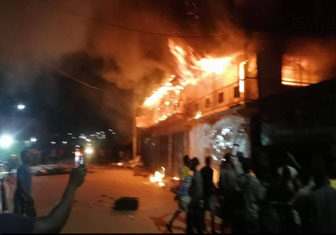
A massive fire broke out on Monday evening, March 9, 2026 on Broad Street in Gbarnga, destroying a chain of commercial stores and leaving business owners counting heavy losses.
The incident exposed the national government’s failure to provide even basic emergency services in Bong County.
Eyewitnesses said the fire started in the early evening and quickly spread through several upstairs buildings.
Shop owners and nearby residents rushed to save goods and properties, but many valuables were consumed by the flames before they could intervene.
Residents expressed anger and frustration at the absence of professional firefighting support. Bong County, a central hub in Liberia, reportedly had no fire truck or trained personnel available. Locals attempted to contain the blaze using buckets of water and improvised methods, but their efforts were largely overwhelmed by the intensity of the fire.
“We had to fight the fire ourselves because there was no fire truck here,” one resident said, visibly frustrated. Another added, “Bong County is central to Liberia, yet we were left defenseless in an emergency. This is unacceptable.”
Reports indicated that a fire truck was being sent from Nimba County, but delays allowed the fire to spread further, worsening the destruction. By the time assistance arrived, much of the properties had already been destroyed, underscoring the consequences of the county’s inadequate emergency preparedness.
Community leaders said the incident reflected years of government neglect.
Despite repeated calls for investment in emergency infrastructure, counties such as Bong remained dangerously under-equipped, leaving residents to face disasters alone.
Residents called on the national government and elected officials to urgently establish a permanent fire service, with trained personnel and functional equipment, to prevent similar tragedies in the future.
“This was not just a local disaster, it was a national failure,” one community leader said. “Business owners, families, and livelihoods were put at risk because essential services had been ignored for years.”
The full scale of the damage from the Broad Street fire remained under assessment, but the event had already intensified public scrutiny over accountability, governance, and the government’s commitment to citizen safety.

Comments are closed.