

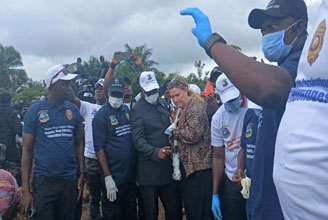

The Liberia Drug Enforcement Agency (LDEA) has disclosed that it confiscated illicit drugs and controlled substances with an estimated street value of more than US$8.2 million.
The arrest, the Agency confirmed occurred between October 2025, and June 2026.
Such situation in the fight against illicit substances highlighted the growing magnitude of drug trafficking despite intensified enforcement operations.
The disclosure came as the LDEA joined the rest of the world in observing this year’s (2026) International Day Against Drug Abuse and Illicit Trafficking.
The event was hosted in Monrovia under the global theme: “Strengthening Communities for a Drug-Free Liberia.”
While officials celebrated enforcement successes, the staggering volume of narcotics seized has raised fresh concerns over the country’s ability to contain the worsening drug epidemic.
In the statistics the Agency released, officers confiscated illegal drugs worth US$8,270,078.39, equivalent to approximately L$1.57 billion, during operations conducted in 14 of the 15 counties.
The figures suggest that large quantities of illicit drugs continue to enter, and circulate throughout the country despite ongoing security interventions.
The seized narcotics included 2,353.396 kilograms of marijuana, 4,263.03 grams of cocaine, 5,880.6 grams of heroin, 15,065.44 grams of Kush, 337,246 pills of tapentadol (tramadol), 413.7 grams of drug precursors, and 2.384 kilograms of methamphetamine.
The quantities have intensified public concern over the effectiveness of border security and the growing sophistication of drug trafficking networks.
County-by-county statistics show that Grand Cape Mount recorded the largest marijuana seizure with 790.4 kilograms, followed by Sinoe County with 503.6 kilograms and Grand Gedeh County with 343.6 kilograms.
Grand Cape Mount also topped the list for Tapentadol seizures, with authorities confiscating more than 200,000 pills, reinforcing fears that the county remains a major gateway for illegal narcotics entering the country.
The report further revealed that Grand Bassa County registered the largest cocaine seizure at 1,514 grams, while Sinoe County accounted for the overwhelming majority of heroin and Kush confiscated, including more than 5.2 kilograms of heroin and nearly 11 kilograms of Kush.
Nimba County led in methamphetamine seizures with 1.5 kilograms, indicating an increasing presence of “dangerous synthetic drugs.”
At program that commemorated the World Drug Day celebration, LDEA Officer-in-Charge, Fitzgerald T.M. Biago, described drug abuse and illicit trafficking as one of Liberia’s gravest threats to public health, national security and economic stability.
Biago warned that narcotics continue to destroy the lives of young people, weaken families and fuel criminality.
He assured that the Agency remains committed to enforce the drug laws, dismantle trafficking syndicates and prosecute offenders.
Biago meanwhile cautioned that arrests and drug seizures alone will not end the crisis, “because defeating drug abuse requires sustained national commitment from every sector of society.”
He called on parents, teachers, religious institutions, community organizations, the private sector, and ordinary citizens to actively participate in preventing substance abuse.
“Stronger community involvement is one of the most effective weapons against addiction, and the exploitation of vulnerable youth by criminal networks.”
Directly to the young people, Biago urged them to reject drugs, and instead, embrace education, vocational training, and other productive opportunities capable of securing a better future.
He further praised members of the security sector, government institutions, healthcare professionals, civil society organizations, international partners, and community leaders for supporting the anti-drug campaign.
He however called for stronger collaboration, public education, and coordinated enforcement efforts to reduce the demand for and supply of illicit drugs.
Despite the Agency’s reported achievements, the enormous quantity of narcotics intercepted in recent times has prompted the public to question whether the current anti-drug strategy is keeping pace with the expanding operations of traffickers.
Many believe the latest figures expose a deeply rooted criminal enterprise that continues to exploit weaknesses in border security and law enforcement.
For that, Information Minister Jerolinmek M. Piah, urged the LDEA to expedite its investigation into the reported US$19 million drug case.
Piah warned that prolonged delays could undermine public confidence in government’s commitment to fight narcotics trafficking.

Comments are closed.