

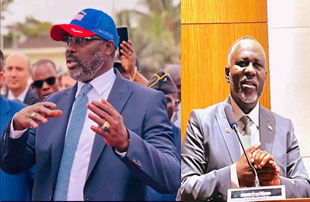

Sources: “Mr. Weah has preferred former Presidential Affairs Minister, Nathaniel Farlo McGill, to become the Party’s next chairman to reflect the competing interests, and expectations surrounding the leadership transition.”
Former President George Oppong Weah has reportedly faced growing pressure from senior officials of the opposition Congress for Democratic Change (CDC).
By that, Weah is to reconsider his position on former party chairman Mulbah K. Morlu Jr., whose possible return to the party’s leadership has generated disagreement among partisans.
According to sources within the party, some senior CDC officials have appealed to Mr. Weah to forgive Morlu for previous public statements directed against him, and support his return to the party’s leadership.
The officials reportedly believe Morlu remains one of the few political figures capable to mobilize the party, and strengthen its grassroots base ahead of future elections.
However, the proposed return has exposed divisions within the opposition party, with some supporters questioning whether Morlu possesses the credibility, and political acceptance required to lead the CDC again.
Critics have argued that leadership should not be determined solely by political influence, or mobilization capacity, but also by trust, discipline, loyalty, and accountability.
Marthaline Kolleh, a strong CDC supporter, questioned Morlu’s suitability for the chairmanship, Madam Kolleh recalled how a controversial remark was attributed to Morlu concerning Weah’s relationships with women in exchange for government appointments.
She described the comments as “embarrassing to the party, the former administration, and the Liberian people.”
Madam Kolleh further alleged that Morlu has provided money to some young people to promote his ambition for the chairmanship.
However, the allegation has not been independently verified, and Morlu’s response was not available at the time of publication.
The claim raises questions about internal campaign practices, and whether CDC’s leadership contest is being influenced by financial inducements rather than a transparent political process.
Another CDC member, Aaron Rodgers, also expressed dissatisfaction with “unfulfilled political promises during the former CDC-led government.”
Rodgers claimed that Morlu had promised to assist him in securing employment at the National Social Security and Welfare Corporation (NASSCORP), “but when I visited the institution, I was informed by the Director General that no official communication concerning his employment had been received.”
Rodgers said, the experience weakened his interest in CDC politics. He argued that the party failed to deliver opportunities to some of its supporters despite their commitment during the administration.
He disclosed how he would prefer former Presidential Affairs Minister Nathaniel McGill to become the party’s next chairman to reflect the competing interests, and expectations surrounding the CDC’s leadership transition.
Meanwhile, another source within the senior leadership structure claimed that Morlu was not being seriously considered for the chairmanship, and should instead concentrate on how to strengthen his political organization, Solidarity and Trust for a New Day (STAND).
The source also questioned Morlu’s previous performance as CDC chairman. The source argued that his leadership did not achieve capable to strengthen the party’s political structures.
In response to questions surrounding his political future, Morlu has explained to partisans why he resigned as CDC chairman in 2024. He described the decision as a “difficult, but necessary sacrifice to prevent internal divisions, and a prolonged leadership crisis that followed the party’s defeat in the 2023 elections.”
He said, he stepped aside to preserve peace, stability and unity, but wants the party remains peaceful and progressive rather than allow internal political battles to threaten its survival.
Morlu also expressed confidence that the CDC remains strong, and capable of playing a significant role in the 2029 elections.
Nevertheless, Morlu’s explanation has not eliminated the questions surrounding his possible return particularly among supporters who believe the party must first address internal grievances, political disagreements, and concerns about past leadership.
For Mr. Weah, the dilemma is whether bringing Morlu back could strengthen the CDC’s political machinery, or deepen existing divisions.
As the party looks toward 2029, its ability to reconcile competing interests, restore grassroots confidence, and establish credible leadership arrangements may prove more important than the return of any single political figure.
