

By Godgift Harris
According to the report, ordinary Liberians are among those most affected when public institutions fail to protect resources, deliver essential services and guarantee equal access to justice.
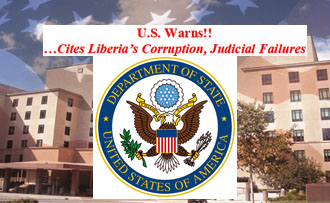
The United States Department of State, has warned of endemic corruption. It also raised concerns about weaknesses in the judicial system.
The warning placed renewed pressure on the Unity Party-led government to demonstrate concrete progress in her fight against corruption, and vigorously recommit to uphold the rule of law.
The concerns, highlighted in the 2026 U.S. Investment Climate Statement, point to “persistent institutional challenges.”
Some of the challenges include corruption risks in government transactions, delays in resolving commercial disputes, and allegations of bribery, and improper interference in judicial proceedings.
Although the assessment focuses partly on the investment climate, its implications extend far beyond foreign businesses.
According to the report, ordinary Liberians are among those most affected when public institutions fail to protect public resources, deliver essential services and guarantee equal access to justice.
Corruption in public procurement remains a major concern, “because government contracts involving roads, hospitals, schools and other development projects can become vulnerable to abuse when transparency and effective oversight are lacking.”
Such practices, the report said, if established, could undermine development spending, and deny citizens the services they desperately need.
For a country struggling with poor road networks, inadequate healthcare, unemployment and limited public services, the misuse of public funds raises questions about whether the national budget is translating into meaningful improvements in people’s lives.
The reported weaknesses in the judicial system also raise concerns about ordinary citizens seeking justice in land disputes, employment cases, property disagreements and other legal matters.
Delayed court proceedings, and allegations of bribery, or external interference risk creating a justice system in which access to fair treatment becomes increasingly difficult.
By the report, Pres. Boakai’s administration now faces questions about whether its anti-corruption promises have produced measurable results.
Since taking office on a platform of accountability and good governance, the government has repeatedly emphasized commitment to fight corruption, but the public needs evidence of progress beyond official statements, and policy announcements.
The Liberia Anti-Corruption Commission (LACC) must also demonstrate its effectiveness by providing credible updates on investigations, prosecutions, recovered public funds and cases involving individuals accused of abusing public office.
“Opening investigations alone cannot satisfy citizens if those investigations fail to produce meaningful accountability.”
Meanwhile, the Ministry of Justice and the Supreme Court bear the greatest responsibility to address concerns about judicial delays, protecting judicial independence and strengthening safeguards against bribery and improper influence in court proceedings.
The concerns Washington raised present a difficult test for an administration that has promised to restore public confidence in government institutions.
The challenge is not simply to convince international investors that Liberia is safe for business, but to assure citizens that public institutions work in their interest.
Liberia investment potential in mining, agriculture, energy and infrastructure cannot be fully realized without credible institutions, predictable laws and an independent judiciary.
The responsibility rests with the administration, and relevant public institutions to respond with transparency, credible investigations and measurable reforms.
Boakai anti-corruption campaign will produce tangible results, or continue to be defined by promises while allegations of corruption, and institutional weaknesses persist.
