

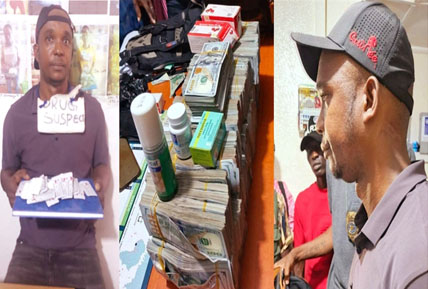
Over USD $1M Drugs Arrested At Bo-Waterside
By: Godgift Harris

By: Godgift Harris
A major seizure by the Liberia Drug Enforcement Agency (LDEA) at the Bo-Waterside Port of Entry has once again exposed the scale of suspected illicit trafficking activities passing through Liberia borders, raising troubling questions about enforcement gaps, institutional capacity, and the growing threat drugs pose to national security.
On Thursday, March 26, 2026, at approximately 5:00 PM, LDEA officers conducting what authorities described as a “routine search” arrested a 45-year-old man identified as Alpha M. Jalloh, a Guinean national and resident of Mamba Point in Monrovia.
The suspect was apprehended while operating a blue Toyota mini-bus bearing Guinean license plate BH-5002.
According to LDEA authorities, the search of the vehicle led to the discovery of two packs of Tapentadol Tramadol an opioid-based substance often associated with abuse across West Africa.
While the quantity seized may appear relatively small, the implications of its presence are significant, especially given the broader context of Liberia’s ongoing battle with drug abuse among its youth population.
More alarming, however, was the discovery of a staggering USD $1,187,000 in cash concealed within the vehicle.
The money, reportedly hidden in compartments designed to evade detection, has intensified suspicions that the case may involve more than simple drug possession, potentially pointing to a wider network of cross-border trafficking and money laundering.
Authorities have placed the suspect under custody as investigations continue, assuring the public that due process will be followed.
Yet, for many Liberians, this assurance offers little comfort in the face of what appears to be a growing and deeply entrenched crisis.
The Bo-Waterside seizure is not an isolated incident, it follows closely on the heels of another recent operation by the same LDEA team, which resulted in the confiscation of illicit drugs and an additional USD $150,000 in cash.
The recurrence of such high-value seizures within a short timeframe suggests that Liberia’s borders remain vulnerable to exploitation by traffickers.
Despite repeated assurances from authorities, critics argue that these incidents point less to effective enforcement and more to systemic weaknesses that allow such activities to flourish in the first place.
Bo-Waterside, a key entry point between Liberia and Sierra Leone, has long been identified as a high-risk corridor for smuggling.
The porous nature of Liberia’s borders, coupled with limited surveillance infrastructure and alleged corruption, has made it increasingly difficult for security agencies to maintain control.
Public reaction to the latest seizure has been swift and critical.
Many Liberians view the incident as further evidence that the country is becoming a hub for drug trafficking in the sub-region.
“There is no way such a huge amount of money and drugs can pass through our borders without some level of complicity,” said one resident in Monrovia, reflecting a widely held sentiment among citizens.
This growing distrust is fueled by the perception that while arrests are occasionally made, the larger networks behind these operations remain untouched.
For many, the real masterminds of the drug trade continue to operate with impunity.
Beyond the headlines and statistics lies a more profound and devastating impact, the toll on Liberia’s young people.
Drug abuse has become a pervasive issue in Monrovia and surrounding communities, with increasing numbers of youths falling victim to addiction.
Communities across Montserrado County report a steady rise in cases involving substance abuse, often linked to drugs like Tramadol.
The situation has contributed to a cycle of crime, unemployment, and social instability, further straining already fragile communities.
Observers have indicated that unless urgent and comprehensive measures are taken, Liberia risks losing an entire generation to the scourge of drugs.
Government promises under scrutiny, when Joseph Nyuma Boakai assumed office, he declared drugs “Public Enemy Number One,” pledging a robust crackdown on trafficking and abuse.
However, the persistence and apparent escalation of drug-related incidents has led many to question the effectiveness of the government’s strategy.
Critics have argued that the administration has yet to translate its rhetoric into meaningful action.
While the LDEA continues to make arrests, there seems to be a little evidence of a coordinated national strategy that addresses both supply and demand.
Moreover, the continued presence of “at-risk youth” on the streets, many of whom are vulnerable to drug abuse, underscores what some see as a failure of social intervention programs.
“The government created the problem of at-risk youth, and today those same young people are still in the streets,” one community advocate remarked.
“Parents are losing their children every day.”
Reports from rural counties suggest that mining areas, particularly those associated with gold and diamond extraction, have become hotspots for drug distribution.
Speaking to journalists over the weekend, Josephine Kolleh, a businesswoman from Gbarpolu County, described a troubling situation in her community.
“Gold mines and diamond mines are now the center points for drugs,” she said.
“Young children are destroying themselves every day, the government needs to act not only in Montserrado but across the country.”
Her comments highlight a broader issue, the spread of drug trafficking networks into remote areas where law enforcement presence is limited and economic opportunities are scarce.
National Security Implications
Security experts warn that the unchecked flow of drugs into Liberia poses a significant threat to national stability.
Beyond the immediate health and social consequences, drug trafficking is often linked to organized crime, corruption, and even regional insecurity.
The large sums of money involved in these operations raise concerns about money laundering and the potential financing of other illicit activities.
In this context, the USD $1.187 million seizure is not just a law enforcement success it is a stark reminder of the scale of the challenge facing the country.
While the LDEA has reaffirmed its commitment to combating drug trafficking, many believe that a more holistic approach is needed.
This includes strengthening border security, enhancing intelligence-sharing with regional partners and investing in rehabilitation and prevention programs.
Equally important is the need for transparency and accountability within security institutions.
Without addressing allegations of corruption and inefficiency, efforts to combat drug trafficking are likely to fall short.
The Bo-Waterside seizure may be seen as a victory for law enforcement, but it also exposes deeper systemic issues that cannot be ignored.
As Liberia grapples with the growing threat of drug trafficking, the stakes have never been higher.
For many citizens, the question is no longer whether drugs are entering the country but how much, how often, and with whose knowledge.
Until these questions are answered, and decisive action is taken, incidents like the USD $1.187 million seizure will continue to serve as both a warning and a call to action for a nation at a critical crossroads.

Comments are closed.