

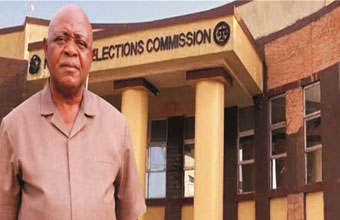

By Domingo Dargbeh
“The proposed investment is to strengthen the Commission’s operational capacity, and ensure the effective conduct of credible elections,” –Weedor.
Authorities at the National Elections Commission (NEC) have proposed a budget of US$89,545,353.92 to conduct the 2029 elections.
The money, covers a three-year implementation period (2027 to 2029).
The proposed budget represents a 40 percent increase over the cost of conducting the 2023 elections.
The Commission has submitted the new proposal to lawmakers on Capitol Hill in Monrovia, and the Ministry of Finance and Development Planning for consideration.
NEC Chairman, Jonathan K. Weedor, told a major press conference on Monday, November 23, that the proposed amount for 2029 elections, also covered the compliance status of political parties.
Weedor: “The projected increase is primarily driven by the expansion of voting precincts, improved internet connectivity, and the procurement of additional voter verification and biometric registration equipment.”
On the expansion of voting facilities, the Commission projects an increase in the number of voting precincts from 2,080 during the 2023 elections, to approximately 2,514 for the 2029 electoral cycle.
NEC also anticipates establishing approximately 10,000 polling places, based on an average of four voting centers per precinct. It used an estimated national population of 5,885,979, where the Commission intends to target approximately 2.7 million eligible voters during registration exercise, which is scheduled for the first quarter of 2028.
The Commission said, improved internet connectivity is another major component of the proposed budget.
The initiative is to provide reliable internet services across its operational areas, particularly between NEC headquarters, and its field offices.
The latest idea is to strengthen communication, coordination, and the overall management of electoral activities nationwide.
Additionally, NEC plans to invest in voter verification systems, information and communication technology, and biometric voter registration equipment to enhance the credibility, and efficiency of the electoral process.
Weedor disclosed how the Commission intends to procure more than 10,000 voter verification devices to authenticate voters before they cast their ballots.
The devices will prevent multiple voting, and reinforce the democratic principle of “one person, one vote.”
The proposed US$89.5 million budget is meanwhile, structured around the implementation phases, beginning in 2027 and extending through 2029.
For the first phase, covering activities in 2027, the Commission has requested US$32,500,581.58 to facilitate the timely procurement of biometric equipment considered essential to the voter registration process.
NEC emphasized how the first-phase funding should be made available by the end of March 2027, to ensure that procurement activities are completed within the required timeframe.
The Commission is to outline the remaining two phases as part of its financial plan for the 2029 electoral cycle.
Weedor meanwhile, stressed the importance of adequately financing the electoral process.
He noted that the proposed investment is to strengthen the Commission’s operational capacity, and ensure the effective conduct of credible elections.
