

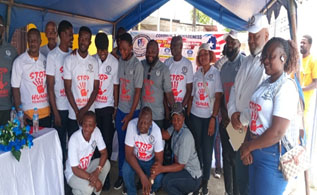
National Campaign To Combat Trafficking Launched
By Domingo Dargbeh

The Liberia Anti-Trafficking and Scam Victims Support Initiative (LATSVSI) has hosted a national awareness campaign under the theme: “Say No to Human Trafficking! Say No to Scam!” The event, which began with a parade from Broad Street to Benson Street, converged government officials, law enforcers civil society representatives, and community members. They addressed the reported growing threats of human trafficking, and online scams.
Zokerseh B. Saye, Executive Director of LATSVSI, explained how LATSVSI was created to combat human trafficking, and scams that are “destroying our children and families.”
Saye was concerned about fake jobs, scholarships, and travel promises, which have been used to deceive, exploit, and abandon young people often in an (inhabited) environments.
“Today alone, we have rescued over 100 victims, and we are currently caring for survivors from Liberia, Nigeria, Ghana, and Sierra Leone.” Samuel G. Ford, Chief of Community Service of the Liberia National Police, highlighted the need for collective action against human trafficking, and online scams. “Human trafficking and online scam are not distant crimes. Criminals now intercept individuals through dangerous, and deceptive travel arrangements, and social media platforms, luring unsuspecting individuals into trafficking situations.”
Ford warned that victims often discovered too late that their documents have been confiscated, their freedom restricted, and their labor exploited.
He spoke of how Liberia as a country has experienced the deep-seated consequences of conflict, displacement, and institutional fragility, must work hard to protect its people from “the menace of exploitation and deception.” “Our young people represent one of Liberia’s greatest assets. Their energy, talents, and aspirations are essential to our national development. We can never allow criminal networks to turn their inspiration into instruments of exploitation.”
He called for a shift from reacting to crimes after damage has been done to prevent them before they occur. That act, Ford said, requires sustained community education, stronger institutional coordination, strengthened law enforcement, and victim support services.
The responsibility of the police goes beyond arresting offenders and prosecuting criminals to include preventing crime, protecting the vulnerable, and responding to the needs of the communities we serve.
Ford said, police cannot fight the crimes alone, but to include community leader; religious institutions, schools, parents, and civil society organizations to collaborate in reporting suspicious activities.
“A community that reports suspicious activity is a community that refuses to remain silent”
