

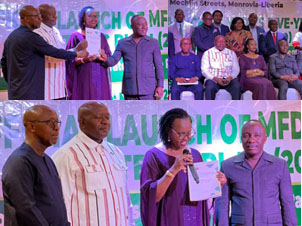

The Ministry of Finance and Development Planning (MFDP) has officially launched its Strategic Plan (2026–2030), setting the tone for a new era of fiscal discipline, institutional accountability, and people-centered governance.
At the launch ceremony at the EJS Ministerial Complex in Congo Town on Wednesday, Finance and Development Planning Minister Augustine Kpehe Ngafuan framed the plan not as a routine policy document, but as a decisive instrument to safeguard Liberia’s future.
He conveyed greetings from President Joseph Nyuma Boakai, describing him as “the Captain of the ship steering Liberia toward renewal, responsibility and results.”
“With profound responsibility and renewed determination, we gather here today to officially launch the Strategic Plan of the Ministry of Finance and Development Planning for the period 2026 to 2030,” Minister Ngafuan declared, emphasizing that the plan is ultimately about restoring public trust and ensuring that government works for the people.
He underscored that the blueprint belongs to ordinary Liberians—not officials.
“This plan is not for me, nor for the deputy ministers or consultants. The plan is for the Liberian people,” he asserted. “We public servants are tenants. The real owners of the house—the landlords—are the people.”
Throughout his remarks, the Minister stressed the central role of the MFDP in national governance, warning that the Ministry’s performance directly determines the effectiveness of the entire government.
“If the Ministry of Finance performs well, most likely the government performs well. And if we don’t perform, we paralyze the government,” he stated, reinforcing the urgency of disciplined execution.
The 2026–2030 Strategic Plan establishes clear, measurable targets aimed at modernizing financial management systems, strengthening fiscal reporting and accountability, enhancing debt sustainability, expanding domestic resource mobilization, accelerating digital transformation, professionalizing the public financial management workforce, and eliminating inefficiencies that slow service delivery.
Describing the document as “a roadmap to actualizing the ambitions of the people,” Minister Ngafuan emphasized that the reforms are grounded in Liberia’s fiscal realities. He announced plans to review the Ministry’s enabling legislation and pursue institutional reforms, including strengthening the Office of the Comptroller and Accountant General to ensure greater operational independence and integrity. Feasibility studies for the construction of a permanent headquarters are also planned to support long-term institutional stability.
“Programs will be tracked rigorously, reported openly, and accountability will be non-negotiable,” he affirmed.
Reiterating that implementation—not rhetoric—will define success, the Minister concluded: “We have conceptualized, we have analyzed, and we have strategized. But good plans and good intentions are not enough. We must work the plan. We must sweat the plan. We must walk the talk.”
Also addressing the gathering, Senator Prince K. Moye, Chair of the Legislative Committee on Ways, Means, Finance and the Budget at the Liberian Senate pledged full legislative backing to ensure the plan’s successful implementation.
He highlighted the importance of improving funding disbursement processes and strengthening domestic revenue mobilization, noting that without reliable revenue performance, government programs in health, education, infrastructure, and agriculture cannot be sustained. According to him, the plan provides a structured pathway for aligning budget credibility with national development priorities.
The Chair of the Joint Committee Representative P. Mike Jurry was full of praise for the transformation at MFDP and hoped that the new Strategic Plan will accelerate the progress of the nation.
For her part, United Nations Resident Coordinator to Liberia, Christine N. Umutoni, who officially launched the Strategic Plan described it as a transformative blueprint capable of translating national aspirations into measurable development outcomes.
She commended Liberia’s 23 years of peace and democratic stability and noted the country’s growing global standing, including its current role as a non-permanent member of the United Nations Security Council. She emphasized that stronger fiscal governance and transparency will enhance investor confidence, attract responsible private sector participation, and deepen development partnerships.
Earlier, Deputy Minister for Administration Bill McGill Jones outlined practical reforms that will drive the plan’s implementation.
He emphasized the Ministry’s commitment to building a digitally driven institution that reduces processing time, harmonizes financial systems across government, and strengthens fiscal discipline.
Central to this transformation, he noted, is the expansion of the Integrated Financial Management Information System (IFMIS), improved compliance in financial reporting, and reinforced debt sustainability frameworks to secure macroeconomic stability. Reporting compliance across government entities, he revealed, has risen from approximately 30 percent to more than 90 percent—an achievement the Ministry aims to consolidate by pushing toward full compliance nationwide.
The Strategic Plan launch brought together members of the diplomatic corps, international partners, the legislature and other senior government officials amongst others.

Comments are closed.