

Kaffa Questions Billion-Dollar Revenue Milestone
By: Abraham K. Morris

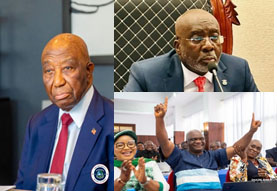
The former Speaker of the House of Representatives, Cllr. Jonathan Fonati Koffa, has renewed his call for a US$25 million social welfare fund to support economically vulnerable Liberians, raising concerns about the apparent disconnect between the country’s growing domestic revenue and worsening poverty.
Koffa’s renewed appeal comes as Liberia celebrates surpassing US$1 billion in domestic revenue collections within the first nine months of 2026, while a recent World Bank report indicates that extreme poverty increased despite the country’s continued economic growth. In a statement, the former Speaker questioned the extent to which the government’s improved revenue performance is benefiting ordinary citizens, particularly those struggling to meet basic household expenses.
“The World Bank is reporting that the number of Liberians in extreme poverty is on the rise. I will renew my call for a $25 million social welfare fund to help Liberians with rent, tuition, and emergency health care. We can’t be bragging about billion-dollar revenue while our citizens slide into extreme poverty. Rising tides must lift all boats,” former Speaker Koffa noted.
The Grand Kru County lawmaker’s comments have renewed public attention on the need to ensure that Liberia’s economic gains translate into tangible improvements in the lives of ordinary citizens.
According to a recent World Bank October 2026 Liberia Economic Update, titled “Beyond Growth: Addressing Structural Constraints to Job-Rich Growth in Liberia,” the country’s economy expanded by 5.1 percent in 2025, as compared with 4.0 percent in 2024.
Despite this growth, the World Bank noted that extreme poverty increased from 34.6 percent in 2024 to 36.1 percent in 2025. Furthermore, the report indicates that the estimates are based on the international poverty threshold of US$ 3 per person per day, measured in 2021 purchasing power parity (PPP).
The World Bank attributes the increase in extreme poverty to inflationary pressures, sluggish agricultural growth, and structural weaknesses that continue to restrict employment and income-generating opportunities.
Also, the report pointed to the concentration of economic growth in capital-intensive industries, particularly mining, as a major obstacle to inclusive economic development. While the mining sector expanded by 17 percent in 2025, agriculture, which employs approximately 39 percent of Liberia’s workforce, recorded growth of only 2.6 percent, down from 3.4 percent in 2024.
Hence, the rising cost of essential goods and services has further compounded the situation. Non-food inflation averaged 9.9 percent in 2025, compared with 6.7 percent in 2024, with healthcare, housing and utilities among the major contributors. Consequently, these economic pressures continue to erode household purchasing power, placing additional burdens on low-income families, informal-sector workers, market women and rural communities.
It can be recalled that Liberia’s domestic revenue performance has improved considerably over the past three years. On September 15, 2026, the Executive Mansion announced that the country had surpassed US$1 billion in domestic revenue collections within the first nine months of the year, marking a historic milestone in domestic resource mobilization.
The Liberian Revenue Authority (LRA) figures show that domestic revenue increased from US$612 million in 2023 to US$699 million in 2024 and US$848 million in 2025. The government has set a target of approximately US$1.3 billion by the end of December 2026, with President Joseph Nyuma Boakai describing the achievement as a significant step toward strengthening the country’s capacity to finance national development priorities and reduce dependence on external financing.
However, the World Bank’s poverty findings have raised questions about whether increased government revenue is translating into meaningful improvements in household welfare. The report indicates that capital expenditure declined from US$406 million in 2024 to US$297 million in 2025, even as the government improved its fiscal position and reduced the budget deficit to 2.1 percent of GDP.
The report highlights persistent challenges confronting private businesses, including limited access to financing, high production costs, inadequate infrastructure and weak market connections.
These constraints continue to undermine the ability of agriculture, manufacturing and small businesses to expand operations, create jobs and improve household incomes.
Against this economic background, former Speaker Koffa proposed a US$25 million social welfare fund intended to provide targeted assistance to vulnerable citizens in three critical areas: housing, education and emergency healthcare. The proposed fund, according to Representative Koffa, represents approximately 2.5 percent of the country’s US$1 billion domestic revenue milestone.
Under the proposal, economically disadvantaged households would receive rental assistance to help prevent evictions and housing insecurity. Students from financially struggling families could also benefit from tuition support to enable them to continue their education. Also, the fund would further provide emergency medical assistance to individuals and families unable to afford urgent healthcare services.
However, implementing such a program would require clearly defined eligibility criteria, transparent disbursement procedures, independent auditing, regular public financial reporting, and legislative oversight. These safeguards would be essential to prevent political interference, minimize potential abuse, and ensure that financial assistance reaches the intended beneficiaries.
Meanwhile, President Boakai has previously outlined his administration’s commitment to ensuring that increased domestic revenue translates into tangible benefits for Liberians, including improvements in public education, healthcare delivery, public-sector salaries, and support for market women.
The President has also indicated that the government is considering a dedicated financing mechanism to provide affordable credit to Liberian-owned businesses and support productive sectors of the economy. The implementation of these commitments will be important in determining whether Liberia’s improved fiscal performance can produce meaningful economic opportunities and better living conditions.
The World Bank, meanwhile, has called for a more diversified, employment-intensive and inclusive growth model, emphasizing greater investment in agriculture, infrastructure, private-sector development and job creation. As Liberia celebrates its historic revenue achievement, Koffa’s renewed proposal has brought the question of social protection back into the national economic debate.
At the heart of the discussion is whether the country’s growing financial resources can be converted into practical support for citizens struggling with rent, school fees, medical expenses, and limited employment opportunities.
Economic analysts have emphasized that while surpassing US$1 billion in domestic revenue represents a significant national achievement, the broader measure of economic progress will ultimately be determined by how much that growth improves the lives of ordinary Liberians. For millions of households facing economic hardship, the benefits of national growth must be reflected in the ability to afford necessities, keep children in school, access emergency medical treatment, and secure decent employment. The challenge before the Boakai administration is therefore not only to generate more revenue, but to ensure that the benefits of that revenue reach the people who need them most.
