

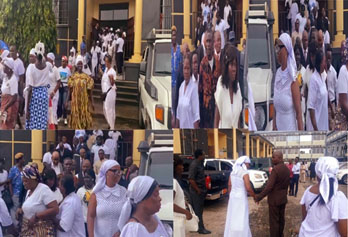

The maxim: “Fun can’t finish” became real at Criminal Court ‘C’ on Tuesday, June 23 in Monrovia when Nora Finda Bundoo first appeared with horde of “prayer warriors.”
Madam Bundoo faces multiple charges, but she rallied “prayer warriors” dressed in white robs around her.
She formerly served as a “chief of protocol” assigned to former President George Weah.
Prior to meeting Mr. Weah, Madam Bundoo was a cook bowl seller in Fish Town, River Gee County.
Members of the “prayer warriors,” dressed in all white gathered at the Temple of Justice on Tuesday, June 23, 2026, to support Madam Nora Finda Bundoo, as she made her first appearance before Criminal Court ‘C.’
She faces the charge in connection with corruption-related allegations the Assets Recovery and Property Retrieval Task Force (AREPT) had pursued.
The unusual display of “faith and solidarity” drew attention from court observers as Madam Bundoo, appeared before the court amid an ongoing legal battle that has become part of government’s campaign to investigate and recover “misappropriated public assets.”
Madam Bundoo arrived at the courthouse accompanied by “supporters and dozens of women clad in white garments,” many of whom, identified themselves as “prayer warriors.” The group gathered at the Temple of Justice early Tuesday morning, offering “prayers, worship,” and words of encouragement before and after the court proceedings.
Their presence attracted significant attention from onlookers; a scene which transformed the grounds of the courthouse to where faith and legal proceedings unfolded side by side.
While the “prayer warriors” focused on spiritual intervention, proceedings inside the courtroom centered on important legal questions surrounding the defendants’ criminal appearance bond.
Presiding Judge Ousman F. Feika, heard arguments on a motion to justify sureties AREPT and the Ministry of Justice filed. The motion seeks to require the individuals who signed the defendants’ criminal appearance bond to demonstrate their legal and financial capacity to serve as sureties.
Prosecutors identified the sureties as Counselor Abraham W. Simpson, Reverend Fayiah Falambo, and Mrs. Tina Falambo.
Prosecutors argued that the sureties should be required to testify under oath regarding their qualifications and ability to guarantee the bond.
Government also raised concerns regarding an attorney simultaneously serving as both defense counsel and surety in the same case.
Madam Bundoo, and her co-defendants are facing money laundering, theft of property, misuse of public money, criminal conspiracy, forgery, and criminal facilitation charges.
The allegations form part of ongoing efforts by authorities to investigate and recover assets allegedly linked to the misuse of public resources.
Following discussions between the prosecution and defense, Judge Feika suspended the hearing, and ordered the matter reassigned for continuation on Thursday, June 25, 2026, at 9: a.m.
The upcoming proceedings are expected to determine whether the defendants’ current bond arrangement satisfies legal requirements, or whether new sureties may be required.
As Madam Bundoo departed the courthouse following the hearing, the “prayer warriors” surrounded her in “prayer and worship.”
They expressed the hope that justice would prevail. Their continued show of support underscored the emotional and symbolic dimensions of a case that has attracted growing public attention.
The former Chief of Protocol, who once occupied one of the most influential positions within the Executive Mansion, is among several former government officials whose cases have emerged from government’s intensified focus on accountability and asset recovery.
The proceedings have drawn attention not only because of the allegations involved, but also because of Madam Bundoo’s prominent role during the administration of Weah.
The gathering also prompted discussions on social media, particularly Facebook, as well as among critics of Mr. Weah’s administration about the intersection of “religion, public accountability and justice.” While supporters viewed the “prayer gathering” as an expression of “faith and solidarity,” others questioned whether public demonstrations of “religious support” should accompany high-profile corruption-related proceedings.
As the case progresses, public attention is expected to remain focused on the evidence presented by prosecutors and the defense mounted by Madam Bundoo’s legal team.
The outcome of government’s challenge to the defendants’ bond could significantly influence the next phase of the proceedings and determine whether the current bond remains valid.
While “prayers and worship” may provide comfort and hope to the accused and her supporters, the ultimate determination of guilt or innocence will rest on the evidence presented before the court, and the judgment rendered through the legal process.
Source: Smart News Liberia

Comments are closed.