

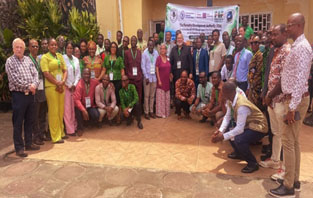
FDA, FAO Conclude Forest Policy, Strategy Validation
Writes Macpherson C. Marbiah

The Forestry Development Authority (FDA) has concluded a day-long workshop on the validation of National Forest Sector Policy and Strategy 2026-2035.
FDA initiated the workshop in collaboration with the Food and Agriculture Organization (FAO), with support from the European Union (EU) and Forest for the Future (F4F).
The validation engagement was held under the theme: “Rejuvenation of the Forest Sector.”
It was expected to safeguard the forest management for the next ten years, when finalized.
The event converged stakeholders from the FDA, FAO, EU, F4F, government ministries, and agencies, civil society organizations, as well as Community Forest Management Associations (CFMAs). They formally validated the documents.
The event was held in Paynesville, outside Monrovia.
FDA Managing Director, Rudolph J. Merab, said the institution is in the process of validating a new sector policy and strategy to increase timber productivity, and community benefits, thus transiting from an unreal policy to an implementable strategy focused on sustainable development.
Merab noted that the policy will move Liberia away from exporting only round logs to establish local processing facilities, create sawmills near resource areas to also provide jobs, and direct benefits to host communities.
He clarified how conservation does not mean total cessation of activity, rather a technical management as the Authority, and its partners will ensure that host communities gain access to resources for trade and other usages.
“The primary objectives include, increasing timber harvesting volumes from the current 63,000 cubic meters toward a target of 500,000 to 700,000 cubic meters. Shift away from exporting raw round logs to focus on value-added processed wood products, and move toward a model where approximately 50 percent of production is processed for domestic and export markets.”
As regards how the local populations will benefit from increased forestry activity, Merab said, the proposed strategy emphasizes localized economic growth through the establishment of processing facilities that will create jobs.
Success, Merab said, requires collective effort rather than individual interests. As such, he called on the stakeholders to work together under a single mandate for the good of the country and its people.
“This new direction aligns with the President’s agenda to ensure that resources benefit the people, and create jobs, as government seeks to increase national revenue by adding value to forest products before they are exported.”
The European Union Policy Officer, Maria Winnubst, disclosed how the EU aimed to support the forest sector’s implementation after consultations with key stakeholders.
“Successful engagement occurred during rounds of consultation held two to three weeks ago, which I find very engaging already to date, and I am encourage that in between, we had quite a few content-wise inputs that came by email, and then the discussions today again. I feel there is an ownership, definitely with the FDA, but I think also among the stakeholders.”
Madam Winnubst noted how stakeholders, and FDA demonstrated strong ownership regarding the discussed content.
As such, the EU will continue its support to the forest sector, and find ways to assist also in the implementation of the new framework documents.
“The FAO is already here, represented by at least three experts to provide technical support, while the EU intends to continue supporting the forest sector in determining how best to assist in the finalization, and upcoming implementation stages of the documents.”
FAO Lead Technical Advisor on Forestry, Godwin Phylix Cudjoe, described the process as “highly consultative.”
Cudjoe said, FAO has already identified six to eight action under pillar one of the documents, which concerns sector governance.
He advised that key focus be place on ensuring that the same consecutive processes used during the formulation of the document, are applied during its implementation to ensure results for people and nature.
“These identified actions align with the existing EU funded forestry program. The EU has committed to send funds to Liberia to support improvements within the sector.”
He noted how the successful finalization of the new framework documents aim to provide the necessary guidance for future work within the sector.
“The session confirmed progress on FAO’s forestry Strategy, aligning six to eight actions with the EU-funded programs, and secure future EU and partners funding for implementation.”
Experts reported that Liberia’s forest sector has remained at a very critical junction because the forest industry that existed before the civil war has never recovered, thus, leaving vast areas of production forest unmanaged.
As a result, forest lands are no longer sufficiently managed and protected, opening the way for a steadily mounting influx of people onto forest lands for mining, farming, expansion, charcoal production, wildlife poaching and other activities.
The National Forest Policy and Implementation Strategy of 2006 (section 3.2), forest policy address the need to resume control over the forest estate, and rehabilitate the economy in the face of receding natural forest cover, increased poaching and illegal harvesting; due to the weak management of the forest estate in the past, the need for a change driven by strong political will couple with appropriate forest governance is essential.
The present Forest Sector Policy and Strategy 2026-2035, is meanwhile, developed in compliance with the forest law, demonstrating how FDA will resolve the current critical situation, and resume control over the sector, and rehabilitate the forest economy for the common good of all Liberians. Writes Macpherson C. Marbiah
