
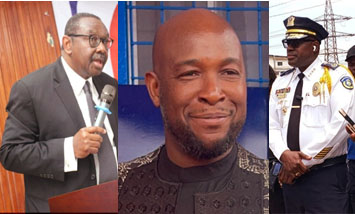

The Minister of Justice and Attorney General, Cllr. N. Oswald Tweh, alongside Police Inspector General, Gregory Coleman, has firmly rejected allegations linking President Joseph Nyuma Boakai’s son, Joe Boakai Jr., to two of the country’s largest cocaine seizure cases.
The officials made the clarification during a joint press briefing on Thursday, July 30, amid growing public speculation surrounding the ongoing investigations.
The officials said investigators have uncovered no evidence connecting Joe Boakai Jr. to either the US$19.2 million cocaine seizure at Roberts International Airport or the record US$317.68 million cocaine haul discovered in Margibi County.
Both cases, they stressed, remain under active investigation by the Joint National Security Task Force with support from international law enforcement partners.
Addressing concerns over the spread of unverified claims, Inspector General Coleman warned against accusing individuals without credible evidence.
He said investigations must be guided by facts rather than speculation, cautioning that misinformation could undermine the integrity of the ongoing criminal probe.
Coleman emphasized that the government’s objective remains the complete dismantling of the drug trafficking network allegedly operating within Liberia.
He maintained that anyone found responsible regardless of political affiliation, social standing, or official position will be prosecuted in accordance with the law.
The Police Inspector General also disclosed that the United States Drug Enforcement Administration (DEA), along with other international security partners, is assisting Liberian authorities by reviewing evidence collected during the investigation.
He described the collaboration as an important step toward ensuring an impartial and comprehensive investigation.
However, Coleman expressed concern over what he described as the growing circulation of unverified reports by some media outlets and on social media platforms.
He warned that inaccurate reporting could distract investigators and potentially compromise ongoing efforts to bring those responsible to justice.
He called on journalists and media institutions to exercise professionalism, responsibility, and caution when reporting on the high-profile narcotics cases.
According to him, accurate and fact-based reporting is essential to maintaining public confidence while investigators continue their work.
Clarifying his comments, Coleman stressed that his criticism was not directed at the entire media community.
Instead, he said his concerns were aimed at individuals and institutions knowingly spreading unverified information, adding that “those involved know themselves.”
Despite the government’s categorical denial of allegations involving the President’s son, the high-profile nature of the cocaine cases continues to generate widespread public interest.
Civil society organizations, opposition figures, and the public have repeatedly called for maximum transparency and accountability as the investigations progress.
The twin cocaine investigations—valued at approximately US$19.2 million and US$317.68 million, respectively remain among the largest narcotics cases in Liberia’s history.
As authorities continue their probe with international support, public attention is expected to remain focused on whether the government can deliver a credible, transparent, and impartial conclusion that withstands public scrutiny.

Comments are closed.