
Catch – 22 Scenarios:
Who's Protecting Traffickers, Kingpins?

The numbers are staggering, US$100m, another US$19.2 million, hundreds of kilograms of cocaine, multiple arrests, years of investigations, legislative probes, public outrage and still, countless unanswered questions. Today, Liberia stands at a dangerous crossroads.
In less than four years, Liberia has witnessed some of the largest narcotics seizures in its history, exposing what authorities have described as sophisticated international drug trafficking networks operating through Liberian territory.
Yet, with every major seizure comes a troubling reality as drugs are intercepted, while many Liberians continue to raise concern as to whether the masterminds behind these operations are ever truly being brought to justice.
The question echoing across the nation is simple but disturbing: ’ Who is protecting the traffickers and kingpins?’ Now, the same issue returned to the center of national attention this June 2026 after authorities intercepted approximately 237.6 kilograms of cocaine valued at an estimated US$19.2 million concealed in cargo moving through Roberts International Airport.
The recent huge quantity of cocaine seizure has immediately ignited public concern and renewed fears that Liberia may be increasingly vulnerable to becoming a strategic transit point for international narcotics syndicates. For many citizens, however, the latest seizure was not an isolated incident, it was a reminder of a huge US$100 million cocaine seizure in 2022, one of the largest drug busts ever recorded in Liberia.
This seems to also be a reminder of previous arrests, investigations, prosecutions, and controversies; especially so despite years of enforcement efforts, cocaine, marijuana, kush, tramadol, heroin, and other dangerous substances continue to find their way into Liberian communities with devastating consequences.
The recent seizure seemingly indicates that the public still lacks satisfactory answers to some of the most important questions surrounding major drug trafficking operations, including who finances these shipments? Who coordinates their movements? Who facilitates their passages through ports, airports, and border crossings? Who profits from the trade? And most importantly, whether there are individuals in positions of power knowingly or unknowingly providing protection to these criminal enterprises? These questions have become even become crucial as lawmakers intensify legislative scrutiny of the latest cocaine seizure.
Since the latest seizure and with mounting public concerns and eyebrows, the House of Representatives has summoned officials of the Liberia Drug Enforcement Agency (LDEA), airport authorities, customs officials, and the Ministry of Justice to provide answers regarding the circumstances surrounding the shipment and the status of ongoing investigations.
Meanwhile, public pressure continues to mount, as political commentators, civil society organizations, religious leaders, youth groups, and ordinary citizens are demanding greater transparency and accountability.
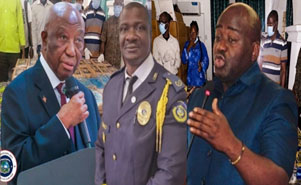
Many have argued that every major seizure appears to expose only a portion of a much larger network whose most influential actors remain hidden from public view. The latest controversy gained additional momentum following remarks attributed to popular Talk-show host and political commentator, Stanton Witherspoon, on the Spoon TV show, who publicly questioned whether individuals connected to powerful institutions may have facilitated trafficking activities.
His comments generated intense public debate because they originated not from a political opponent of the administration but from someone widely perceived as a supporter of President Joseph Nyumah Boakai. The allegations remain unverified, and no evidence has been publicly presented linking President Boakai or senior Executive Mansion officials to the current cocaine case.
However, authorities have consistently maintained that investigations remain active and that no government official or individual has been implicated based on evidence publicly disclosed thus far, yet public suspicion persists.
Not necessarily because evidence has emerged against specific individuals, but because Liberians have repeatedly witnessed major drug cases generate headlines, arrests, and public promises, only for many questions to remain unanswered long after public attention fades. But beyond politics, beyond the accusations and denials, beyond the investigations and press conferences, lies the true tragedy of Liberia’s drug crisis.
Across Monrovia and throughout the counties, communities are watching a generation slowly drift into addiction, crime, hopelessness, and despair. Families are being torn apart, schools are losing students, communities are becoming less secure, mental health challenges are increasing, while parents are watching helplessly as their sons and daughters become trapped by substances that promise escape but deliver destruction.
Against this painful backdrop, one of Liberia’s most prominent political figures and businessman, Representative Musa Hassan Bility, has entered the national conversation with a message that has struck a deep emotional chord.
Representative Bility entered the debate seemingly not as a politician, a political leader, or as a government critic, but as a father. In a powerful open letter addressed to President Boakai, Bility revealed that his own son is currently incarcerated on drug-related charges. The disclosure has transformed the national discussion from one centered solely on politics and law enforcement into a deeply personal reflection on the human cost of Liberia’s drug epidemic.
“My son is in jail today because he was caught in possession of drugs,” Bility wrote. As painful as the admission was, he accepted that his son must face the consequences of his actions. Yet he also argued that the responsibility cannot end with arresting users while those who import and distribute narcotics continue to operate. His appeal was direct and emotional.
He appears to speake not only for his son but for thousands of Liberian families suffering in silence. Bility described a generation whose future is being stolen by addiction, while challenging the government to confront drug trafficking without fear or favor. Also, the Nimba County lawmaker warned that history would judge any administration that fails to act decisively against those responsible for poisoning Liberian youth.
His words have apparently resonated far beyond party politics because they captured a growing national concern that Liberia’s drug crisis is no longer merely a criminal justice issue. Rather, it is a public health emergency, a social crisis, an economic threat, and increasingly, a national security challenge.
Today, Liberians are demanding more than seizures, more than arrests, more than press conferences, more than promises, rather, they are demanding accountability, transparency and results. The Boakai Administration most likely finds itself confronting one of the defining governance challenges of its tenure.
Whether the ongoing investigation ultimately reveals an international trafficking network, local collaborators, corrupt actors, institutional failures, or no involvement by public officials whatsoever, many citizens believe the nation can no longer afford uncertainty. The stakes are simply too high because every kilogram of cocaine that enters Liberia represents more than a criminal transaction.
It represents another family shattered, another dream destroyed, another future stolen, another young Liberian lost. Unless decisive action is taken to dismantle the networks behind the trade, the next seizure may expose a crisis even larger than the last.
For many Liberians, the question is no longer whether the country has a drug problem. The question now is whether Liberia possesses the political will, institutional courage, and national resolve to identify and confront those who stand behind the traffickers and kingpins before an entire generation is lost.

Comments are closed.