

By Domingo Dargbeh
“The rice contained physical toxins, foreign ingredients, insects, and dirt, thereby raising concerns about its safety and quality for human eating,”—Madam Gray.
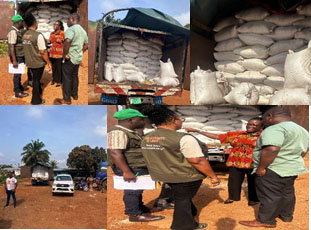
The Food Authority of Liberia (FAL) has intercepted a truckload of rice suspected to be “unsafe, rotten” for public consumption.
The seizure was carried out in the Nezo Community, a proximity of crime prone Paynesville Red-Light, outside Monrovia.
FAL implemented the order in collaboration with the Environmental Protection Agency (EPA), the Ministry of Commerce and Industry (MoCI), the Ministry of Health (MoH), and the Liberia National Police (LNP).
The truck, bears license plate number C-41762, was confiscated as authorities launched an investigation into how the rice entered the country without the required labels, approvals.
FAL Acting Director General, Madam Georgettie N. Gray, told a news conference that more than 426 bags of rice were intercepted, and determined: “unsafe for human consumption.”
Additional quantities of such rice were also discovered in the same community, but at different location.
Madam Gray: “Preliminary examinations FAL conducted unearthed physical toxins, which include foreign materials, insects, and dirt. The discovery raised concerns about the rice’s safety and quality for human eating.”
She explained how the rice lacked proper product identification, and traceable information; making it difficult for authorities to establish its origin, importer, and other relevant details.
In the aftermath of the interception, the Food Authority, with the police and EPA, have launched an investigation to determine the origin, and circumstances that surrounded the consignment.
Madam Gray also disclosed how a suspect arrested earlier in connection with the incident was released to his lawyer under a “recognizance arrangement” that was signed at the police station.
She said, the discovery raises public health and safety concerns, particularly, “rice being the country’s staple food.” Madam Gray assured the public that relevant authorities will work together, and investigate the matter to determine the next appropriate course of action.
The operation forms part of ongoing efforts to protect public health, and prevent the distribution of “unsafe food products.”
