

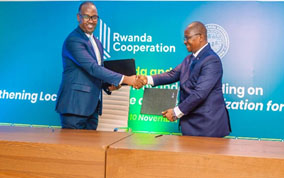

Liberia and Rwanda have signed a Memorandum of Understanding (MoU) to strengthen local governance, advance decentralization, improve public service delivery, and promote local economic development through technical cooperation.
The agreement, according to a release, was signed on Tuesday, November 10, by Liberia’s Ministry of Local Government, and the Rwanda Cooperation Initiative (RCI). It was signed under the theme: “Strengthening Local Governance and Decentralization for a Better Liberia.”
Deputy Local Government and Decentralization Minister, Edward K. Mulbah, signed on behalf of the Ministry at a ceremony attended by Rwandan officials, representatives of the United Nations, government officials, and members of the press.
Mulbah described the agreement as more than a formal document, saying: “it represents a commitment by Liberia to learn from Rwanda’s experience in rebuilding institutions, and improve public service delivery.”
He noted that both Liberia, and Rwanda experienced devastating conflicts, and faced the challenge of rebuilding national institutions, and restore public trust.
While Rwanda experienced the 1994 genocide, Liberia endured 14 years of civil conflict.
Mulbah said, both countries have pursued different approaches to rebuild, with Rwanda emphasizing institutional discipline, human capital development, and efficient public services.
He pointed to Rwanda’s governance, and service delivery practices, including Imihigo, Umuganda, and Irembo, as examples from which Liberia could draw lessons.
Mulbah also referenced Liberia’s Local Government Act of 2018, which provides a legal framework for transferring power, authority, and resources to counties, cities, towns and villages.
However, he stressed that legislation alone cannot guarantee improved services at the community level, making practical implementation and institutional capacity essential.
Mulbah outlined three major pillars of the agreement, including learning, institutional strengthening, and service delivery.
Under the first pillar, the two countries will facilitate technical exchanges, and study visits to enable Liberian officials to understand Rwanda’s institutional arrangements, governance systems, and digital service delivery mechanisms.
He disclosed how approximately 20 days before the signing ceremony, a 28-member Liberian delegation comprising officials from five ministries, agencies, and commissions visited Rwanda to study its governance and public administration systems.
The delegation examined institutional structures, service delivery models, and digital infrastructure, including the Irembo platform, which enables citizens to access government services electronically.
The team also visited institutions in Kigali, and other districts to observe Rwanda’s approaches to local administration, community participation, sanitation, and public service delivery.
Mulbah said the officials returned with the responsibility of adapting relevant lessons to Liberia’s counties and communities.
He emphasized that the purpose of the exchange was not simply to observe Rwanda’s development experience but to identify practical approaches that could improve governance and service delivery in Liberia.
The second pillar focuses on building stronger local government institutions through training, professional development, and technical cooperation.
Mulbah: “Rwanda’s Management Institute (RMI) is expected to establish a partnership with Liberia’s planned Local Government Training Institute (LGTI) to strengthen the technical capacity of local government officials and personnel.”
Through the proposed institutional partnership, the two institutions will explore opportunities to incorporate relevant Rwandan experiences into Liberia’s training programs.
These include performance management through Imihigo, local revenue collection, sanitation management, community participation through Umuganda, and digital public administration through Irembo.
Mullbah said, the cooperation will strengthen the professional capacity of local government personnel and support the development of more effective governance structures.
The third pillar focuses on translating lessons from Rwanda into practical improvements in public service delivery.
Under the MoU, the two parties will support the development of a digital service delivery framework for Liberia’s County Service Centers, taking into consideration the country’s legal, institutional, technological, and operational circumstances.
The agreement also provides for identifying and digitizing priority public services, improving coordination among government institutions, and strengthening the capacity of personnel responsible for delivering services at the local level.
It further seeks to promote the integration of public services at County Service Centers to make government services more accessible, efficient, and responsive to citizens.
Beyond digital governance, the agreement places significant emphasis on local economic development and value addition.
The cooperation will support knowledge exchange on policies and practical approaches for adding value to Liberia’s mining, forestry, and agricultural sectors.
Priority areas include promoting local processing, manufacturing, and commercialization of natural resources, including gold and agricultural commodities.
The two sides will also explore ways to strengthen local governments’ capacity to identify economic opportunities based on their respective natural resources, attract private investment, and promote public-private partnerships.
Other areas include skills development, entrepreneurship, technology transfer, investment promotion, improved local revenue generation, and environmentally sustainable resource management.
While expressing appreciation for Rwanda’s development experience, Mulbah emphasized that Liberia must adapt the lessons to its own national circumstances rather than replicate them without consideration of local realities.
“Based on the learning from here, we will adapt, not to photocopy, because Liberia is not Rwanda. We have our own Constitution, our own customary law, and our own customs and traditions,” he said.
He referenced Articles 5 and 65 of Liberia’s Constitution, noting the importance of preserving the country’s cultural heritage and ensuring that customary and statutory laws operate alongside one another.
He described the signing as a potential turning point in Liberia’s decentralization efforts, provided that the commitments are translated into practical programs to improve the lives of citizens.
The agreement marks another step in Liberia’s efforts to strengthen local governance, and bring public services closer to citizens, particularly through the implementation of the Local Government Act of 2018.
