

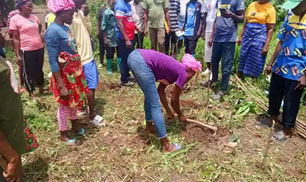

The Development Education Network-Liberia (DEN-L), a non-governmental organization has concluded a three-day training exercise to equip farmers with practical skills in climate-smart agriculture. The training was initiated through the European Union-funded Strengthening Community Actions for Land and Economic Security (EU-SCALES) Project.
It was held in Gbarngasiaquelleh, Panta District, Bong County with 30 farmers from Scaleya-Polu, Noryea, and Gbarngasiaquelleh.
The initiative focused on strengthening farmers’ understanding, and application of climate-smart agricultural practices to improve food production, soil management, environmental sustainability, and household food security.
Participants welcomed the training, which they described as an important opportunity to acquire practical knowledge that could improve farming activities.
They also committed themselves to share the knowledge, and skills gained with other farmers, and farming groups in Panta District.
Joseph Suakollie, a senior trainer at DEN-L, said, the training was designed to promote knowledge-sharing while increasing farmers’ understanding of climate-smart agriculture.
Suakollie underscored the importance of adopting farming practices that can improve farmers’ productivity while responding to environmental and climate-related challenges.
He encouraged participants to take the lessons seriously, and transfer the knowledge gained to other farmers.
Florence N. Toumed of Gbarngasiaquelleh, and Harris Mulbah of Scaleya-Polu, expressed appreciation to DEN-L, and its partners for organizing the training.
They also expressed the hope that participating farmers would share the knowledge acquired with those, who were unable to attend the three-day training.
Meanwhile, Jacob Dennis, the lead practical trainer, urged participants to apply the lessons learned, particularly in the production, and use of local compost as an environmentally friendly farming practice.
Dennis also encouraged farmers to reduce their reliance on insecticides, and other potentially harmful agricultural chemicals.
He said, excessive or improper use of agricultural chemicals can affect soil quality, and create potential risks to human health and the environment.
The training forms part of ongoing activities under the EU-SCALES Project, which seeks to strengthen local agricultural capacity, and promote sustainable farming practices among rural communities.

Comments are closed.