

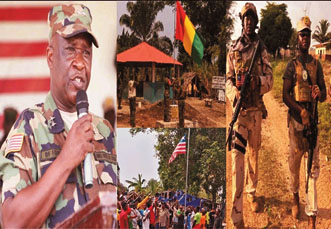
Liberia/Guinea Border Dispute Lingers:
Who Is In Control?

“The deployment of well-trained and armed immigration officers demonstrated Liberia’s growing capacity to professionally and peacefully secure its territorial entry points,” –AFL Chief of Staff Forleh.
His remark has generated public discussion about the security situation at Sorlumba, particularly as questions remain over the actual authority exercising control at the disputed border area.
The disputed Sorlumba border area between Liberia and Guinea has resurfaced with lingering report of fresh military concern from the Guinean soldiers.
The resurgence at the border followed Armed Forces of Liberia (AFL) Chief of Staff, Major General Davidson Forleh claims that the deployment of heavily armed Liberian Immigration Service (LIS) was necessary to restore law and order in a “peaceful and orderly manner.”
For that, there are reports that the Guinean officers have raised concerns within its ranks and files.
Due to Forleh’s statement, there conflicting accounts about who currently controls the area?
The assurance has also left many Liberians now demanding clarity from the government as to the actuality at the disputed borderline.
Forleh said, the deployment of well-trained and armed immigration officers demonstrated Liberia’s growing capacity to secure its territorial entry points.
His remark has generated public discussion about the security situation at Sorlumba, particularly as questions remain over the actual authority exercising control at the disputed border area.
Forleh: “AFL trained more than 100 Immigration Service officers, approximately four months ago, with particular emphasis on firearms training and border security responsibilities.”
He said, the training had strengthened the capacity of immigration personnel to protect the entry points, and respond to security challenges.
Forleh spoke during the graduation ceremony of 37 members of LIS’s first band unit.
He recounted an incident in which he allegedly received a telephone call from Guinea’s Army Chief of Staff following the deployment of immigration officers to Sorlumba.
Forleh claimed that his Guinean counterpart had expressed concern about the presence of heavily armed personnel, reportedly believing they were AFL soldiers rather than immigration officers.
He further said the Guinean military chief had previously advised against deploying Liberian soldiers to the border, “because the two countries were not at war.”
Forleh interpreted the reported reaction as a sign of confidence in Liberia’s security sector.
He argued that the appearance and preparedness of the immigration officers had demonstrated the Service ability to perform their duties professionally.
The account, as presented by Forleh, one critic said, does not independently establish which country exercises effective control over the disputed territory.
More importantly, information attributed to a source within the border area contradicts the impression created by Forleh’s remark.
The source maintains that Guinean personnel remain in control of Sorlumba to present, though “peaceful on duty.”
If accurate, that account raises serious questions about the current security arrangements, the extent of Liberia’s authority in the area, and whether the deployment of immigration officers has changed the situation on the ground for the best of fraternities.
The conflicting claims expose the need for the Liberian government to provide a clear, evidence-based explanation of the Sorlumba situation.
The presence of armed immigration officers, the reported concerns of a foreign military chief, and public declarations of security preparedness are not by themselves, sufficient proof of territorial control, according to an insider.
Critics have demanded from authorities to clarify the location of the disputed boundary; the status of security deployments, and the diplomatic steps being taken to prevent further tension between the two neighboring countries.
Meanwhile, Forleh has announced plans to establish a National Band Unit comprising personnel from AFL, the Liberia National Police and LIS.
He also urged graduates of the immigration service first band unit to maintain discipline, and professionalism.
He warned them against using their uniforms to intimidate citizens. Although the initiative concerns institutional development, the government immediate responsibility at Sorlumba remains ensuring that border security operations are lawful, coordinated, and consistent with national interests.
