

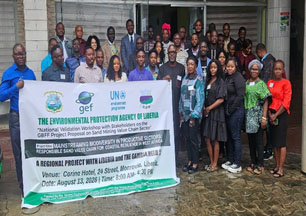

The Environmental Protection Agency (EPA), in collaboration with the United Nations Environment Programme (UNEP) and various national and international partners, has successfully concluded a one-day National Validation Workshop aimed at enhancing responsible sand management and safeguarding Liberia’s coastal and riverine ecosystems.
The workshop held over the weekend, convened representatives from government ministries, agencies, local authorities, civil society and non-governmental organizations, academia, private sector actors, community representatives, development partners, and international organizations.
Participants gathered to review and validate the draft project proposal titled “Mainstreaming Biodiversity in Productive Sectors: Responsible Sand Value Chain for Coastal Resilience in West Africa.
”This initiative is a 36-month regional project endorsed by the Global Environment Facility (GEF) under the Global Biodiversity Framework Fund (GBFF) and is being developed by UNEP in partnership with the EPA of Liberia and The Gambia’s National Environment Agency (NEA).
The project aims to tackle the environmental and social impacts associated with unsustainable sand extraction, which include coastal erosion, habitat degradation, biodiversity loss, pollution, and increased vulnerability of communities to flooding and other climate-related threats.
Additionally, the initiative seeks to enhance governance of the sand value chain, strengthen policies and regulations, improve institutional coordination, promote responsible sourcing and sustainable alternatives, and create biodiversity-positive livelihood opportunities for communities reliant on sand resources.
The national validation workshop represented the final major consultative step before the proposal is submitted to the GEF for review and approval.
In his opening remarks,EPA Executive Director Dr. Emmanuel K. Urey Yarkpawolo emphasized that the initiative should not merely be viewed as a regulation of sand mining, but rather as a comprehensive effort to balance natural resource use, biodiversity conservation, livelihoods, and national development.
He acknowledged the critical role of sand in construction and national development, but warned that its extraction without proper planning, regulation, and restoration could lead to severe consequences.
Dr. Yarkpawolo pointed out that unsustainable sand mining can accelerate coastal and riverbank erosion, destroy habitats, degrade water quality, expose communities and infrastructure to flooding and storm impacts, and threaten local livelihoods, particularly fishing.
He noted that weak monitoring, fragmented institutional responsibilities, and limited sustainable alternatives contribute to the continuation of harmful practices.
The proposed project is designed to address these challenges throughout the entire sand value chain by strengthening scientific evidence and baseline information, improving policies and regulations, enhancing institutional coordination and enforcement, and promoting responsible sourcing and sustainable alternatives.
Furthermore, it aims to support biodiversity-positive livelihood opportunities, particularly for women, youth, and vulnerable communities.
“In simple terms, the project connects science to policy, policy to the market, and the market to improved livelihoods and environmental protection,” Dr. Yarkpawolo explained.
He underscored the importance of national ownership, asserting that international support must translate into stronger institutions, expertise, and accountability in Liberia. “National ownership is not achieved merely by placing Liberia’s name on a document. It is achieved when our institutions, communities, businesses, experts, and civil society meaningfully shape the project and accept responsibility for its delivery,” he stated.
He urged participants to critically examine the draft proposal, challenge assumptions, identify gaps, and suggest practical solutions rather than simply endorsing the document.
Assistant Minister for Planning, Research, and Development at the Ministry of Mines and Energy, Emmanuel Vaye, acknowledged the significance of sand as a vital resource for national development, particularly within the construction sector.
However, he cautioned that improper extraction can lead to coastal erosion, ecosystem degradation, and other environmental challenges.
Vaye described the validation workshop as an important opportunity for stakeholders to review, refine, and collectively strengthen the proposed interventions before submitting the project to the GEF.
He emphasized the need for careful attention to data and planning, regulatory oversight and enforcement, institutional coordination, and the promotion of more sustainable approaches to sand extraction and construction.
Montserrado County Superintendent Whroway Bryan stressed the importance of placing communities at the center of efforts to address the impacts of sand mining.
He pointed out that the increasing demand for sand, especially for construction, necessitates stronger collective action to prevent environmental degradation and protect the lives and livelihoods of affected communities.
Superintendent Bryan emphasized the need for the project to yield practical measures to halt harmful practices and safeguard the welfare of those living in impacted areas.
Mr. Momodu Michael Kemokai, Country Director of Conservation International, also highlighted the importance of responsible sand management, noting that sand is a crucial natural resource that supports economic development.
He warned that irresponsible sand extraction can lead to significant environmental and social consequences, including coastal erosion, land degradation, habitat destruction, biodiversity loss, and increased vulnerability to climate-related impacts.
Kemokai noted that as development and infrastructure expansion continue, the demand for sand is expected to rise, making it essential to understand the entire sand production and value chain while addressing challenges and promoting economic development and environmental sustainability.
He affirmed that Conservation International believes nature is among the most valuable assets for development, as healthy ecosystems provide critical services that support livelihoods and strengthen resilience to climate change.
The validation workshop serves as an important opportunity for government institutions, sand operators, researchers, civil society organizations, and local communities to collaboratively explore how sand extraction can be better regulated and monitored.
Kemokai called for greater transparency, improved compliance with environmental standards, and sustainable business practices throughout the sand industry.
During the validation exercise, stakeholders reviewed key components of the proposed project, including project design and results framework, policy and institutional framework, governance arrangements, technical interventions, and expected outputs.

Comments are closed.