

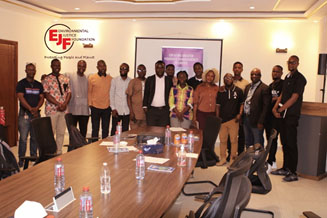

The Environmental Justice Foundation (EJF) has launched a two-day training workshop for 12 journalists to improve media coverage of the fisheries sector, and promote greater transparency, and accountability in the management of marine resources.
The training, held at a resort in Monrovia was conducted under the Oceans5-funded project, “Creating Greater Fisheries Transparency in Liberia.”
The initiative brought together journalists from newspapers, radio, television, and online platforms enhanced their understanding of fisheries governance, illegal fishing, and environmental reporting.
The workshop was organized to equip journalists with the skills needed to effectively report on fisheries-related issues. EJF Program Officer, Augustine Fayiah said, the sector has historically received limited media attention despite its importance to economy, and food security.
Fayiah said, the training had encouraged journalists to focus on critical issues affecting the fisheries sector, including illegal, unreported, and unregulated (IUU) fishing, abuses at sea, and the protection of the Inshore Exclusion Zone (IEZ), which is reserved exclusively for artisanal fishermen. EJF Communications and Media Officer, Abraham N. Nyorkor said, the training was designed to provide journalists with practical knowledge, and investigative reporting skills to better understand the impact of IUU fishing, and expose issues affecting the marine resources, and coastal communities. Nyorkor: “Participants were trained to identify fisheries-related issues of public interest, distinguish facts from opinion, produce accurate, and ethical human-interest stories, and promote accountability, transparency, and sustainable fisheries management through responsible journalism.
The training also introduced journalists to the Global Charter for Fisheries Transparency, an international framework to improve openness, and combating illegal fishing worldwide.
The organization believes stronger investigative journalism will expose challenges within the sector while supporting reforms, and improved governance.
The National Fisheries and Aquaculture Authority (NaFAA) Director of Research, and Statistics, Austine Saye Wehye, commended the journalists for showing interest in reporting on fisheries issues. Wehye praised EJF, and its funding partner, Oceans5, for supporting efforts to strengthen transparency, and public awareness in the sector.
As part of the training, journalists participated in a field visit to the West Point fishing community, where they interacted with artisanal fishermen, fishmongers, and processors to better understand the realities facing coastal communities.
