
Justice Minister Warns Against Unfounded Allegations
By: Godgift Harris

The Justice Minister and Attorney General of Liberia, Cllr. Oswald Tweh, has cautioned Liberians against making unsubstantiated allegations linking government officials to the country’s ongoing high-profile cocaine investigations, even as public frustration continues to mount over the pace of the probes into two of Liberia’s largest drug seizures.
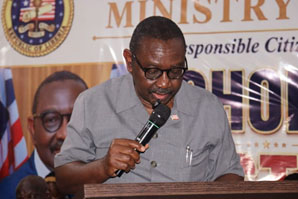
Speaking at the Ministry of Information’s regular press briefing on Thursday, August 6, 2026,
Cllr. Tweh said it has become increasingly common for members of the public and some media commentators to accuse senior government officials and state institutions of involvement in drug trafficking without presenting credible evidence.
He warned that such allegations could undermine ongoing investigations and distract authorities from identifying those truly responsible.
The Justice Minister urged anyone with credible information about the drug cases to submit it to the Government of Liberia for investigation.
He noted that individuals who lack confidence in local authorities are also free to present such evidence to foreign governments through their respective embassies, stressing that the priority should be ensuring justice is served rather than fueling speculation.
His comments have come as public scrutiny intensifies over investigations into the approximately US$317 million cocaine seizure discovered in Duazon along the Roberts International Airport Highway and the earlier US$19.2 million cocaine seizure involving cargo processed through Global Logistics Services (GLS) at Roberts International Airport.
Despite repeated assurances from the Ministry of Justice and the Joint Security Task Force that investigations are progressing, many Liberians remain unconvinced that authorities are pursuing everyone connected to the trafficking networks.
Critics have argued that while arrests have been made, the investigations appear to have focused largely on lower-level suspects, with no prominent officials or influential figures publicly linked to the cases.
As weeks have passed without major public breakthroughs, skepticism has continued to grow.
Civil society organizations, political commentators, and ordinary citizens have increasingly questioned whether those who financed, organized, or protected the alleged drug operations will ultimately be held accountable.
Political commentator Joggers Nelson echoed those concerns, questioning what he described as an imbalance in the investigations.
“Where are the big hands behind this drug cartel? What is the delay? Why are you going after the smallest men and leaving the big guys?” he asked, reflecting sentiments widely expressed on social media and in public discussions.
Government officials have consistently rejected suggestions of a cover-up, maintaining that investigators are following evidence rather than public pressure.
Justice authorities insist that dismantling transnational drug trafficking organizations requires extensive international cooperation, forensic analysis, and careful legal procedures to secure successful prosecutions.
Amid the criticism, some observers have praised the National Security Agency (NSA) for its reported intelligence work that helped expose the alleged drug operations.
However, they argue that intelligence successes must now be followed by transparent investigations and prosecutions that inspire public confidence in the justice system.
As public scrutiny continues to intensify, the credibility of the government’s anti-drug campaign may ultimately depend not on appeals for restraint, but on whether investigators can demonstrate that the law applies equally to everyone from street-level operatives to the alleged financiers and powerful individuals behind Liberia’s largest cocaine trafficking cases.
Until then, many Liberians say their calls for accountability, transparency, and equal justice will remain unanswered.

Comments are closed.