

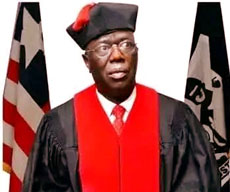
Chief Justice Gbeisay Launches MEA’s Training
By Yassah J. Wright

Chief Justice, His Honor Yamie Quiqui Gbeisay, has launched a four-day monitoring, evaluation, and accountability (MEA) training.
The training is aimed at monitoring and evaluating circuit judges, magistrates and general judiciary staffs.
Gbeisay described the exercise as a milestone in pursuit of justice and accountability.
He underscored the importance of the established judiciary MEA Department.
“Even in your house, if your children are not monitored, they will be roaming the streets. Likewise, in the work place, if the staffs are not monitored, everyone will do things differently. So, monitoring and evaluation is very essential. This department will monitor, evaluate and establish accountability in every aspect of the court system. We will make sure; the department reaches every court in the 15 counties. This department will not only evaluate ordinary judicial personnel, but most importantly, judges,” stated Chief Justice Gbeisay.
“The MEA Department will ensure that the judiciary is trusted, efficient and become a beacon of hope for citizens, and other nationals.”
Gbeisay also called on the other two branches of government (Legislative and Executive) to join the judiciary in making the issue of monitoring and evaluation a top priority at their respective work places.
Also, the MEA Director, Michael Korkpor, said the strength of any judicial system does not only lie in the laws that are upheld, but also in the trust that the judiciary earns from the people it serves.
Cllr. Korkpor added that for that trust to be real and lasting, the judiciary must demonstrate transparency, fairness and continuous improvement.
Korkpor expressed his delight about the start of the training program, noting that with the establishment of an MEA Department, it is essential that the necessary training is acquired by staffs as well as the development of the department work plan.
He noted that an MEA Department is not only just important, but essential, “because it will track how judicial resources are used; how cases progress, and whether to establish procedures.”
Roberts L. Nyahn, coordination analyst, UNDP Liberia, said the MEA is an essential tool for any institution that envisages transparency and accountability.
Nyahn acknowledged some of the challenges that the courts and part litigants are faced with.
He recalled that over the years, the UNDP, in the interest of transparency, has placed into the court premises bill boards that reflect court cost, fees and fines.
UNDP, Nyahn said, has collaborated and supported the Judiciary in its professional Magistrate training program, case management system and development of the strategic plan.
He said UNDP remains committed to its support to the judiciary through the rule of law program.
“This year UNDP is working to develop a new rule of law program, but during the development of the program, the judiciary will be consulted to ensure that its prioritized activities are placed in the new program.
Nyahn described UNDP as a traditional partner to the judiciary.
Associate Justice, Yussif D. Kaba, said it is the time to introduce a more robust monitoring, and evaluation system for the future survival of the judiciary.
Kaba opined that the MEA Department plays a central role in making the judiciary system effective, accountable and fair.
Justice Kaba noted that it is a systemic way to measure how well court and justice institutions perform to identify problems, and to guide and improve without undermining judicial independence.

Comments are closed.