

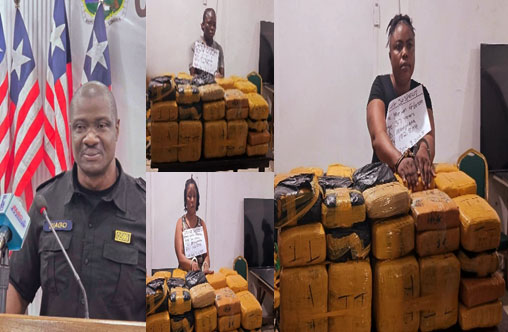

The fight against illicit drugs is intensifying, but beneath the surface of official statistics lies a troubling reality, a system struggling to keep pace with a rapidly evolving narcotics trade that continues to threaten national security and public health.
The Liberia Drug Enforcement Agency (LDEA), in its January-February, 2026, operational update, painted a picture of progress, yet the data also exposes systemic weaknesses that critics say could undermine the broader anti-drug campaign.
Arrests and seizures, progress or a symptom of a growing Crisis?
Within just two months, the LDEA reported 170 arrests and the seizure of 331.84 kilograms of assorted narcotics, valued at nearly US$400,000.
An addition, US$150,000 in suspected drug money was confiscated during a major operation at the Bo Waterside border, a known transit point between Liberia and Sierra Leone.
While these figures suggest increased enforcement activity, they also raise a deeper concern; the scale of the drug problem may be far larger than what is being intercepted.
Security analysts argue that rising seizures often indicate an expanding drug market rather than its decline.
“When you see more drugs being caught, it sometimes means even more are getting through,” a Monrovia-based security expert noted.
LDEA maintains that all suspects have been investigated, and forwarded to court, but the claim has sparked renewed scrutiny of judicial process long criticized for delays, inefficiency, and, in some cases, alleged corruption.
As the justice system comes under pressure, one of the most critical challenges acknowledged by the LDEA itself, is the slow pace of adjudicating drug cases.
Delays in the courts have repeatedly allowed suspects to remain in prolonged pre-trial detention or, in some cases, regain freedom under “questionable circumstances.”
Legal observers warn that without swift and transparent prosecutions, enforcement efforts risk becoming ineffective.
“Arrests alone do not win the war on drugs, convictions and deterrence do,” said a local legal advocate.
The backlog of cases not only weakens deterrence, but also places additional strain on the already overcrowded prison system.
The seizure at Bo Waterside highlights a long-standing vulnerability of the porous border points.
Despite being a key gateway for regional trade, the border infrastructure remains underdeveloped and, in many areas, poorly monitored.
Traffickers are increasingly exploiting these gaps, using the country as both a transit hub and a destination market.
The presence of foreign nationals among those arrested Nigerians, Sierra Leoneans, and Guineans point to a growing regional dimension of the drug trade.
However, experts caution against focusing solely on foreign actors, noting that the overwhelming majority of suspects 146 out of 170 are Liberians.
This underscores the domestic nature of the crisis and the need for internal reforms.
The LDEA has highlighted ongoing reforms, including the training of 220 new recruits at the Liberia National Police Academy, and expanded community outreach programs reaching over 1,800 students.
While these initiatives are commendable, critics argue they may not be enough to confront a sophisticated and well-funded drug network.
The LDEA has also received support from the Ministry of Justice, joint security agencies, and international partners, such as the U.S. Embassy, INL, and the United Nations Office on Drugs and Crime.
Yet public confidence remains fragile, many Liberians continue to question whether high-level traffickers are being held accountable or if enforcement efforts disproportionately target low-level offenders and street users.
Drug abuse, particularly among young people, remains on the increase, contributing to crimes, mental health challenges and community instability.
The LDEA’s latest report reflects both effort and urgency, but it also underscores the magnitude of the challenge ahead.
Without the reforms, the country risks fighting a losing battle one where arrests and seizures continue to rise, but the underlying problem remains unchecked.

Comments are closed.