

Saudi-Donated Rice Hauls 13 Former State Actors For Trial
By: Godgift Harris

Thirteen former government officials and employees are set to face trial today, August 17, 2026, before Criminal Court “C” in Montserrado County over the alleged misappropriation of more than 25,000 bags of rice donated by the Kingdom of Saudi Arabia for disaster victims in Liberia.
The high-profile case is emerging as a major test of Liberia’s efforts to recover public assets and hold officials accountable for the alleged diversion or misuse of humanitarian assistance intended for vulnerable communities.
Those indicted include former Foreign Minister Dee-Maxwell Saah Kemayah, former Internal Affairs Minister Varney A. Sirleaf, former Deputy Foreign Affairs Minister for Administration, Thelma Sawyer, and former Deputy Internal Affairs Minister for Administration, Momolu Johnson.
Also named are former National Disaster Management Agency (NDMA) Executive Director, Henry O. Williams; former General Services Agency (GSA) Deputy Director for Operations, Edris Bility; NDMA Director for Disaster Victims, Augustine Kollie; NDMA employee , Edward S. Konneh.
NDMA Communications Director, Archievego M. Doe; NDMA Logistics Officer, Rosetta L. Gbassay Bowah; Warehouse Manager, Evelyn Gbee; GSA Assistant Director, Mamie Davies; and Wayfa Ciapha, identified as the purported CEO of Group of Seventy-Seven are also being hauled.
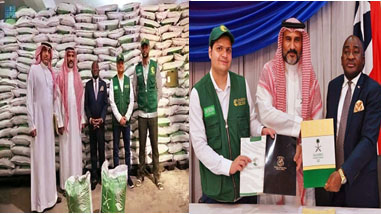
The case originates from a donation of 29,412 bags of 25-kilogram rice valued at approximately US$500,000, which was provided by Saudi Arabia to the Government of Liberia in April 2023.
The rice was intended to support communities affected by disasters across Liberia and was placed in government-managed warehouses for subsequent distribution.
However, an investigation by the Assets Recovery and Property Retrieval Taskforce (AREPT) allegedly uncovered significant discrepancies in the handling and distribution of the consignment.
According to the indictment, 25,054 bags of the donated rice, valued at approximately US$425,918, were allegedly stolen, misapplied, or improperly distributed.
The alleged loss has raised serious questions about the management of humanitarian donations and the safeguards in place to ensure that assistance reaches its intended beneficiaries.
The defendants are facing several charges, including theft of property, economic sabotage, misuse of public money, property or records, theft and/or illegal disbursement and expenditure of public money, misapplication of entrusted property, abuse of office, and criminal conspiracy.
The defendants were indicted in 2025 following the AREPT investigation. After months of pretrial proceedings and discovery, Criminal Court “C” ruled on August 11, 2026, that the case should proceed to trial, with proceedings scheduled to begin at 9:00 a.m. on August 17.
For AREPT, the trial represents a crucial stage in its broader asset recovery mandate, particularly as the government seeks to demonstrate that allegations involving public resources will be subjected to judicial scrutiny rather than administrative handling alone.
In a statement signed by its Public Relations Officer, Joseph F. Daniels, the Taskforce stressed that an indictment does not establish guilt, arguing that the evidence gathered during the investigation must now be presented and tested in court.
AREPT said the judicial process will determine whether criminal responsibility exists and whether restitution or recovery of public assets is warranted under the law.
The Taskforce also pledged to work with the Ministry of Justice while respecting due process, the rights of the accused, and the independence of the judiciary.
The proceedings are expected to attract significant public attention because of the number of former senior officials involved and the nature of the allegations.
Beyond the individual defendants, the case could raise broader concerns about accountability, transparency, and oversight in the management of donor-funded humanitarian assistance.
The outcome could also become an important benchmark for Liberia’s ongoing anti-corruption and asset recovery efforts, particularly in determining whether the justice system can effectively address alleged abuse involving resources intended for some of the country’s most vulnerable citizens.

Comments are closed.