

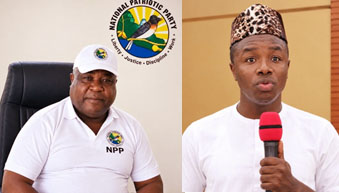

The Congress for Democratic Change (CDC) Secretary General, Jefferson Koijee, has launched a fierce attack on National Patriotic Party (NPP) Chairman, George Mulbah, accusing him of creating unnecessary controversy over an opposition roundtable.
According to him, the NPP was never formally invited to attend.
The dispute followed public comments attributed to Mulbah rejecting what was presented as an invitation for the NPP to participate in a proposed opposition roundtable aimed at bringing together political actors opposed to the government.
Koijee, however, has rejected Mulbah’s account, insisting that the CDC never formally invited the NPP as a political institution or extended an invitation to Mulbah in his capacity as party chairman.
The CDC Secretary General said the organizers only contacted selected individuals associated with the NPP in their personal capacities.
He argued that Mulbah therefore had no basis to publicly reject an invitation on behalf of the party when, according to him, no formal invitation had been sent to the NPP.
Koijee described Mulbah’s response as political grandstanding and posturing, accusing the NPP chairman of unnecessarily turning a routine political engagement into a public controversy.
The CDC official questioned why Mulbah chose to publicly address an invitation that he said was never extended to him or his party.
Koijee also raised questions about Mulbah’s reported employment within the Office of Vice President Jeremiah Kpan Koung.
According to him, the reported connection makes the timing of Mulbah’s statement worth examining and raises questions about whether the NPP chairman’s position could have been influenced by considerations outside the opposition’s efforts to build broader political cooperation.
The accusations seem to have added fresh tension to attempts by opposition political actors to establish common ground as Liberia gradually moves toward the 2029 general elections.
Political parties and movements are increasingly discussing possible alliances, cooperation and electoral strategies, but differences over participation and political interests continue to pose challenges.
Koijee maintained that the CDC remains willing to engage political actors interested in strengthening opposition cooperation.
However, he made it clear that the party would challenge what it considers misleading accounts of its political activities.
The controversy has consequently shifted attention from the proposed roundtable itself to the growing political tensions among opposition actors.
Whether the disagreement will damage future efforts to bring opposition groups together remains uncertain.
For now, Koijee’s response has placed Mulbah and the NPP under intense political scrutiny, while raising broader questions about trust, communication and competing interests within Liberia’s opposition camp.
The dispute underscores the difficulties facing any attempt to forge a united opposition front ahead of the country’s next major electoral contest.

Comments are closed.