
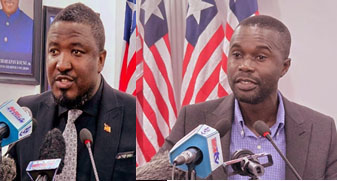

Deputy Information Minister Daniel O. Sando, has taken a combative stance against the President of the Press Union of Liberia (PUL). Though the Minister of Information, Jerolinmick Piah, had recently tussled with journalist Franklin Doloquee over a disputed media coverage, Sando outrightly rejected concerns about threats to press freedom.
He dismissed the allegations against Piah as “misleading and outdated.”
On Thursday, October 2, 2025, at the Ministry of Information weekly press briefing, Sando insisted that the administration of President Joseph Nyuma Boakai, has no record of suppressing the media.
“There has never been a day under this administration that the government has shut down any radio station or newspaper,” Sando said.
He warned PUL President, Julius Kanubah, who he said: “needs to be careful with his statements about the Boakai-led government.”
Sando went further, accusing the Union of turning a blind eye to “reckless practices” in the media, while failing to enforce ethical standards.
His sharp remarks were a direct response to comments made during PUL’s 61st anniversary program in Sinkor, Mr. Kanubah cautioned the Boakai government not to repeat the repressive tactics used by previous regimes.
Kanubah reminded the public of past crackdowns under Tubman, Doe, Taylor, Sirleaf and Weah, and urged vigilance to prevent history from repeating itself.
As part of its anniversary celebrations, the Union announced the reactivation of the National Media Council, a multi-stakeholder body that will investigate complaints, mediate disputes, and promote ethical reporting. The Council is expected to be inaugurated later this month, and will include journalists, civil society, lawyers, women’s groups and religious organizations.
While Sando attempted to soften his message by describing himself and Information Minister Jerolinmek Matthew Piah as “friends of the media,” his remarks have already drawn unease divide between the government mouth piece and the media.
Some journalists interpreted his words as an attempt to silence legitimate criticisms.
Critics note that although no outlets have been forcibly shut down, government’s influence still looms large through selective advertising, restricted access to information, and the precarious working conditions faced by many journalists.
Analysts say the heated exchange exposes a critical test for the Boakai Administration, whether it will strengthen country’s fragile democratic space, and protect independent journalism, or risk undermining the very freedoms it claims to defend.

Comments are closed.