

By Godgift Harris
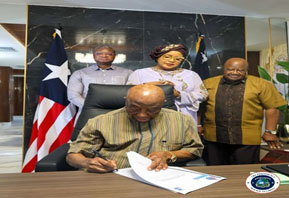
President Joseph Nyuma Boakai has signed the founding Project Charter for the proposed Peace, Reconciliation and Memorial Museum.
The event marked a step to preserved the history of civil conflict, and promote national healing.
The charter was signed on Friday, November 13, ahead of the inauguration of the National Steering Committee, scheduled for November 16–18 at the Executive Pavilion in Monrovia.
Technical delegations from Rwanda and South Africa are expected to arrive between November 14 and 15 to participate in the three-day meeting alongside government officials, the United Nations Development Program (UNDP), civil society organizations and other development partners.
Pres. Boakai signed the document alongside Minister of State without Portfolio Hadja Mamaka Bility, who chairs the National Steering Committee, and UNDP Resident Representative Ambassador Aliou Mamadou Dia, who serves as co-chair.
The charter outlines the museum’s mandate, leadership structure, governance and decision-making procedures.
It also establishes five technical working groups responsible for developing the national historical narrative, archives and collections, governance and legal framework, museum design and visitor experience, as well as education and public engagement.
Pres. Boakai emphasized the importance of confronting the painful past to build a peaceful and united future.
“Liberia cannot build a united future on a past it refuses to remember.”
He added that the museum will preserve the memories of the civil wars, honor victims and survivors, and educate future generations about the importance of sustaining peace.
Madam Bility described the signing as a commitment to national reconciliation. She noted that the proposed institution belongs to all Liberians, and should meanwhile, serve as a platform for remembering the past while strengthening national unity.
Amb. Dia thanked Pres. Boakai for entrusting UNDP with the responsibility of co-chair the committee, and support the development.
He described the initiative as an opportunity to preserve Liberia’s collective memory, and inspire future generations to protect the country’s peace.
The visiting delegations from Rwanda and South Africa are expected to provide technical expertise in historical preservation, museum development, memorialization, reconciliation and post-conflict recovery.
Their participation follows a UNDP-supported study mission to East and Southern Africa led by Madam Bility between August and September 2026.
During the mission, the Liberian delegation visited Rwanda’s Gacaca Archives, and Campaign Against Genocide Museum, as well as South Africa’s Apartheid museum and Freedom Park.
South Africa’s Minister of Sport, Arts and Culture, Gayton McKenzie, also pledged technical support for Liberia’s proposed museum during the engagement.
The upcoming steering committee meeting will focus on archives management, institutional partnerships, museum design, public education and preparations for construction.
Historians, researchers, educators, civil society groups, survivors, young people and communities affected by the civil wars are expected to contribute to the process.
The proposed museum forms part of Pres. Boakai’s National Historical Recovery Initiative, launched in July during Liberia’s 179th Independence Day celebrations in Buchanan, Grand Bassa County.
The initiative seeks to recover historical records, including documents held outside Liberia, and ensure that Liberians play a central role in documenting and preserving their national history.
When established, the museum will collect, verify, preserve and digitize photographs, government records, audiovisual materials and testimonies from survivors of the country’s civil conflicts.
The project also follows Boakai’s public apology on behalf of the Liberian State to victims and families affected by the civil wars.
Which lasted from 1989 to 2003, claimed an estimated 250,000 lives, displaced of people, and left widespread destructions.
