

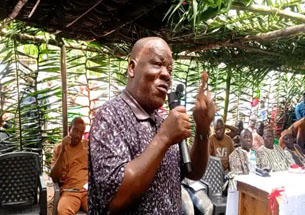

Chief William B.S. Kollie has drawn sharp criticism in Bong County after urging citizens to reject any planned protest in support of former Vice President Jewel Howard-Taylor, a move critic said could be viewed as an attempt to discourage peaceful civic expression.
Kollie, who serves as National Liaison in the Office of President Joseph Nyuma Boakai and also a member of the Traditional Council of Liberia, has publicly opposed any demonstration aimed at defending Howard-Taylor amid her ongoing legal troubles.
He argued that such protest could undermine the national campaign against illicit drugs and send the wrong message at a time when Liberia is attempting to confront narcotics trafficking.
But his position has raised uncomfortable questions about the limits of his role and whether a government-linked traditional leader should be telling citizens which causes they should or should not publicly support.
Howard-Taylor is facing charges arising from an ongoing narcotics investigation. The allegations remain subject to judicial determination, and she is entitled to due process and the presumption of innocence.
For critics, however, the most troubling aspect of Kollie’s intervention is not his opposition to drug trafficking but his apparent effort to discourage a public demonstration before the courts have determined the outcome of the case.
Peaceful protest is a form of civic participation. Citizens may express support for an accused person, demand transparency, criticize prosecutors or question government decisions without necessarily endorsing the alleged conduct underlying a criminal case. Such distinction seems to make Kollie’s argument particularly contentious.
Rather than allowing the courts to determine the allegations while encouraging citizens to remain peaceful, critics contend that Kollie’s approach risks turning a legal matter into a test of political loyalty.
His warning also comes with a political dimension because of his position within the Office of the President.
The connection makes his public intervention likely to attract greater scrutiny, particularly among residents who may interpret his remarks as reflecting the position of the administration.
Kollie has also urged the government to ensure that the case involving Howard-Taylor and everyone else implicated is investigated impartially and handled according to Liberian law.
The demand is welcomed, but critics said impartiality must also include respect for citizens who disagree with government officials, indicating that the government can enforce the law without suppressing peaceful expression, while traditional leaders can promote calm without appearing to dictate citizens’ political or civic choices.
The controversy therefore leaves Kollie facing a difficult suspicion as to his role to discourage citizens from demonstrating or encourage them to exercise their rights peacefully and responsibly.
Chief Kollie’s intervention has already transformed what could have been a debate over one protest into a broader discussion about political influence, traditional authority and the boundaries of government-linked leadership.
For Bong citizens, the message from critics is clear: peaceful civic expression should not be treated as a crime, and support for an accused person should not automatically be equated with support for the alleged offense.
As Howard-Taylor’s case proceeds through the legal system, the courts—not public pressure, political statements or traditional authorities—will ultimately determine the facts and the law.

Comments are closed.