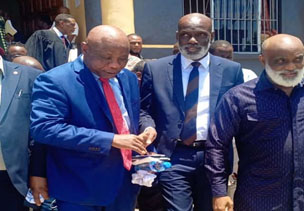
Former Finance Minister Samuel D. Tweah Jr. delivered a forceful and methodical rebuttal to the Prosecution’s case today, as the Court ordered the Governor of the Central Bank of Liberia to appear and authenticate critical defence documents relating to alleged direct transfers.
Under direct examination by lead counsel Arthur Johnson, Tweah systematically dismantled key pillars of the indictment, exposing what the Defence described as fundamental legal and factual weaknesses.
A Structured Legal Offensive
Tweah framed his testimony around “six observations” drawn from the indictment, today focusing primarily on four of these:
* That no request originated from national security actors
* That he lacked lawful authority
* That the transfers through the Central Bank were illegal
* That he conspired with former Acting Justice Minister Nyanti Tuan
Blending public finance law with national security governance—drawing on his role as a former member of the National Security Council – Tweah offered a detailed explanation of ministerial authority under Liberia’s Public Financial Management (PFM) framework.
Redefining the “Trigger” for Public Spending
At the core of his testimony was a direct challenge to the Prosecution’s theory of how public funds are activated.
Tweah explained that:
* For budgeted expenditures, the legal trigger is the passage of the national budget – not a payment request.
* For non-budgeted or emergency expenditures, the trigger is government consensus in response to urgency – not necessarily formal documentation.
He emphasized that requests may or may not exist depending on circumstances, directly undermining the Prosecution’s reliance on the alleged absence of documentation.
Direct Transfers: Not Illegal
In one of the most consequential moments of the hearing, Tweah presented concrete examples of prior government direct transfers executed through the Central Bank:
* Over US$15 million to the National Elections Commission
* US$25 million to the World Food Programme for COVID-19 food support
* US$1 million to UNFPA for the 2022 National Census
He stressed that these transactions were conducted using the same mechanisms now being characterized as “illegal” by the Prosecution.
“This is not an anomaly – it is an established government practice,” the Defence argued in substance.
Court Orders Key Evidence Authentication
When the Defence moved to subpoena the Central Bank Governor to authenticate documentary instructions underlying these transfers, the Prosecution objected, arguing irrelevance.
Presiding Judge Feika overruled the objection and ordered the issuance of a subpoena.
The Governor – or a designated representative – is now expected to appear in court to verify the authenticity of the photocopied documents already submitted into evidence.
Implications for the Case
Legal observers note that, if authenticated, the documents could significantly weaken the Prosecution’s case. They directly challenge prior testimony suggesting that such direct transfers had never occurred, and reinforce the Defence’s argument that the transactions in question were lawful and consistent with established fiscal practice.
The development places increasing pressure on the Prosecution’s central narrative and raises doubts about the legal foundation of the charges.
Court resumes tomorrow at 10:00 AM, with Tweah continuing his testimony.