

Macpherson C. Marbiah writes
The Liberia Maritime Authority (LMA), has included a day-long high-level dialogue on safety, security, and the welfare of seafarers.
The event comes at a time when Liberia is scheduled to take over the presidency of the United Nations Security Council in December 2026. By that, Liberia has domenstrated commitment to advancie maritime security and seafarers protection.
The dialogue focused on examining ways to secure the global maritime domain amid armed conflicts, geopolitical tensions and emerging maritime threats, protection of commercial shipping, freedom of navigation, maritime infrastructure, and seafarers, particularly those operating in conflict-affected areas.
The discussion also focused on strengthening global maritime governance and institutional coordination through renewed international cooperation.
The event is expected to produce a communique, outlining the major discussion, and practical recommendation.
The dialogue was held under the theme: “Enhancing Global Maritime Security and the Welfare of Seafarers for International Peace and Shared Prosperity in a Period of Heightened Insecurity.”
President Joseph Nyuma Boakai declared the event week, and the High-level dialogue on global maritime safety, security and seafarers welfare officially opened on Thursday, November 19, in Marshall.
Pres. Boakai disclosed howvthe mounting threats facing global shipping institutions that include armed conflicts, terrorism and transnational criminal network jeopardized both national and international security.
He said, seafarers including engineers, cook and captains, must be protected under international humanitarian law, as they are often caught in conflicts that disrupt the delivery of food, fuel and medicine.
Boakai highlighted the position as the world’s largest maritime registry by tonnage, exceeding 300 million gross tons.
He said, the government is fully committed to maintain a high quality registry with zero tolerance for substandard ships.
To bolster domestic security, the strategy involved strengthening the Coast Guard, fisheries authority and port systems, so as to enhance the justice system to ensure criminals caught in Liberian waters are prosecuted.
As Liberia prepared to assume the presidency of the United Nations Security Council in December, Pres. Boakai outlined a specific agenda focused on maritime protection.
“We intend to host a high-level debate at the UN, advocate for practical cooperation regarding medical evacuations, crew changes and repatriation.”
Boakai said, government will work along with the International Maritime Organization to reinforce legal obligations, and protect seafarers affected by armed conflicts.
He said the dialogue aimed to identify existing gaps in maritime safety and informed country’s upcoming work at the United Nations, thus highlighting Liberia’s deep historical connection to the sea and it’s identity as a maritime nation.
He said the Maritime Training Institute served as a symbolic venue for discussing the future of the global shipping industry.
He then pledged government fullest commitment to prioritized the safety, security and welfare of all seafarers under the country’s flag.
He urged participants to identify existing gaps and proposed practical solutions for maritime safety, adding that recommendations from the dialogue will directly informed Liberia upcoming work at the UN.
The event celebrates the inaugural Liberia Maritime Authority week, an initiative intended to drive economic growth and national development.
Maritime Authority Commissioner and Chief Executive Officer, Cllr. Neto Zarzar Lighe, said the landmark engagement comes at a significant moment in Liberia’s international affairs, as the country’s prepared to assume the rotating presidency of the United Nations Security Council in December.
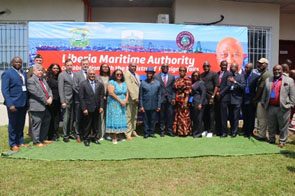
The event brought together senior government officials, members of the diplomatic community, representative from the UN, Maritime Safety and Security Experts, shipping industry leaders among others.
Commissioner Lighe said that maritime transportation remained important to international trade, food security, energy supply and the movement of essential goods.
He said that global shipping continued to face several security threats, including geopolitical tensions, armed conflicts, piracy, cyber-attacks, illegal fishing, human trafficking, drug trafficking among others.
He named the gulf of Guinea and the gulf of the Aden as important maritime corridors facing growing security concerns.
He stressed tthe need to protect commercial vessels must go hand-in-hand with protecting the lives of seafarers, who he said often worked far from their families, and faced dangerous conditions while transporting goods across international waters.
“Liberia position as the world largest flag state comes with respon.
Liberia position as the world largest flag state comes with responsibilities to the international shipping community, and the global community.”
By that, Liberia aimed to promote the Atlantic as a credible alternative shipping lane, at a time when traditional routes are inaccessible.
The dialogue focused on growing threats facing international shipping routes and the seafarers responsible to keep global maritime trade moving. Macpherson C. Marbiah writes
