

Growth Without Development Is A Tragedy’
---Capt. Kollie Laments Liberia's Economic Situation

Amid the ongoing debate about the rate of poverty and the state of the Liberian economy, in the wake of the recent World Bank report, former military officer and politician, Captain Jerry K. Kollie, has proffered what he terms as patriotic and practical recommendations to remedy the country’s current poverty situation.
The World Bank Group released the 7th edition of the Liberia Economic Update (LEU), titled, Beyond Growth: Addressing Structural Constraints to Job-Rich Growth in Liberia. The report acknowledges and highlights that the Liberian economy grew by 5.1% in 2025, but found that economic expansion has not translated into sufficient job creation to boost income generation for poverty reduction, citing poverty rate at 36.1%.
Since its release, the report has, as usual, sparked mixed reactions. Some members of the opposition community have jumped onto it, apparently attempting to emphasize a gloomy picture of the poverty situation for a political advantage, while members and supporters of the ruling establishment are pushing back, and instead pointing to how the current administration has improved on poverty reduction, compared to the immediate past administration.
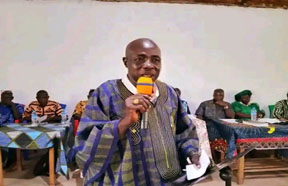
Amid the ongoing discourse, Captain Kollie, a former officer of the Armed Forces of Liberia (AFL), and now a political and social justice advocate, has sought to strike a balance, refusing to insensitively politicize the report, nor blindly defend the glaring slow pace of development to match economic growth.
Speaking Tuesday, November 10, 2026, at a breakfast meeting of some concerned political and civil society representatives in Gbarnga, Bong County, Kollie acknowledged the importance of economic growth, which is the quantitative increase in a country’s real Gross Domestic Product (GDP), national income, or total output of goods and services, measuring how much the economy produces, as in the case with Liberia’s current growth trajectory.
He, however, stressed the need to put more emphasis on economic development, which is the qualitative and multidimensional improvement in a country’s overall standard of living, human capital, education, health care, infrastructure, and social inclusion, which addresses the economic well-being (living standard) of the people.
Captain Kollie framed Liberia’s situation as growth without development, where the economy is experiencing a rise in GDP but with difficulty in improving the living conditions of the people, largely due to what he described as the age-old dependence on a single sector—–n this case, the extractive industry (mining), which generates huge revenue but with low scale employment of local workers, thereby doing little to improve purchasing power in the local economy.
He referenced, as examples, Bea Mountain Mining Company and AcelorMittal as two major mining (extractive) concessions with large-scale operations and massive revenue generation, but with low employment of local workers, and as such, the enormity of their operations is not impacting the economy as it should, in terms of capital flow and poverty reduction.
To change this trend, Captain Kollie advanced two basic recommendations——-agriculture and austerity.
He urged government to prioritize agriculture and direct more resources towards the sector to increase employment opportunities, and expand food production, which would relief the pressure on the economy for food importation.
Kollie also called on President Joseph Nyuma Boakai to take bold steps in instituting austerity measures by drastically cutting down on the cost of running government, in order to save money and invest significantly in the private sector, which is the engine of growth and development.
Such cuts, he stressed, must affect the massive salaries and benefits of some public officials, and the government’s policy on the purchase of extremely expensive vehicles, streamline lavish travels, and restrict government’s programs and activities to public facilities so as to save costs and direct resources towards ventures that directly impact the livelihoods of the people.
