

Liberians Demand ‘Tangible Results’
By Godgift Harris & Domingo Dargbeh

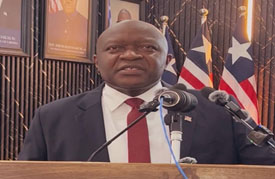
Finance and Development Planning Minister Augustine Kpehe Ngafuan has defended the government’s spending record while outlining a proposed US$1.54 billion national budget for Fiscal Year 2027, amid growing public concerns about whether increased public expenditure is translating into meaningful improvements in the lives of ordinary Liberians.
Speaking Monday, November 9, 2026, at a special press briefing at the Ministry of Information in Monrovia, Ngafuan dismissed criticisms of the government’s spending performance as attempts to “demonize success.” His defense comes as the government prepares to present its proposed FY2027 budget to the Legislature, with increased allocations for healthcare, education, infrastructure, public sector reforms and social protection.
The proposed budget, themed: “A Growing Budget for Bigger Impact: Accelerating the Implementation of the ARREST Agenda for Inclusive Development,” represents an approximately 18 percent increase over the approved 2026 budget. Defending more than US$1 billion in government expenditure, Ngafuan cited investments in healthcare, education, road rehabilitation and public transportation as evidence that spending is benefiting Liberians.
He referenced government intervention to support a hospital reportedly facing closure, the school feeding program and ongoing road projects. He also said improved road connectivity and National Transit Authority buses along the southeastern corridor have reduced transportation difficulties and costs for market women and other residents. However, questions remain about the accessibility, affordability and geographical reach of these services, particularly for low-income households.
Ngafuan acknowledged that Liberia’s development challenges remain enormous, admitting that even a US$1 billion budget cannot address all national needs. He disclosed that ministries and agencies initially submitted funding requests totaling nearly US$3 billion for FY2027, requiring difficult spending decisions.
According to him, approximately US$1.45 billion, representing 94 percent of the proposed budget, is expected from domestic revenue, while US$92 million will come from external budget support. He recalled that Liberia collected more than US$1 billion in domestic revenue by September 2026, describing it as the first time the country had crossed that threshold within a single year.
Ngafuan attributed the achievement to taxpayers, the Liberia Revenue Authority and other government institutions, citing improved tax compliance, revenue administration, economic activities and the proposed transition from the Goods and Services Tax to a Value Added Tax system.
The draft budget also includes US$40 million in contingent revenue, with corresponding expenditure to be released only if projected resources materialize. Development partners are additionally expected to provide approximately US$195.4 million in off-budget development support.
In the health sector, the government proposes US$135.83 million, up from US$110.9 million in 2026, an increase of approximately US$24.93 million. The allocation will support medical staffing, equipment and the full operationalization of the new Redemption Hospital in 2027. Other provisions include US$5.3 million for improvements at the John F. Kennedy Medical Center, US$1.3 million for Jackson F. Doe Memorial Hospital, US$1.5 million for renovations at C.H. Rennie Hospital and US$1.23 million to begin construction of a National Children’s Referral Hospital.
Education is expected to receive US$163.55 million, with approximately US$20 million above its 2026 allocation. The funding will support improvements at the University of Liberia, public schools, Grand Kru Technical College, Booker Washington Institute and Margibi University, among other institutions. The proposed budget also includes US$800,000 for a secure examination printing facility for the West African Examinations Council and US$2.5 million for expanded school feeding and school health initiatives. Infrastructure and basic services are allocated US$142.56 million, including US$49.1 million through the National Road Fund and counterpart financing for major road corridors such as Caldwell to Fish Town, Sanniquellie to Logatuo and Fish Town to Harper.
The government is also proposing US$40 million for the Liberia Electricity Corporation to support electricity generation, expansion and improved revenue collection through smart metering. On public sector compensation, Ngafuan disclosed that proposed interventions are expected to benefit more than 17,000 people through salary improvements, recruitment and regularization of some volunteers.
Also, compensation for qualified public-school teachers, salary adjustments for 358 health workers across 146 facilities and health offices, upward adjustments for 1,934 police officers and a 15 percent salary increase for 616 Liberia Drug Enforcement Agency officers.
Finance and Development Planning Minister acknowledged longstanding salary disparities across public institutions and said the government intends to address them gradually. Regarding retirement benefits, Ngafuan disclosed that nearly US$60 million in accumulated employee contributions remains unremitted to the National Social Security and Welfare Corporation (NASSCORP). The proposed budget provides for the statutory six percent employer contribution, while outstanding arrears will be settled progressively.
Other interventions include recruiting 1,400 young Liberians into the security sector, comprising 800 Armed Forces of Liberia personnel and 600 Liberia National Police officers. The budget also provides US$2 million for motorcyclist empowerment, US$3 million for the national football team, Lone Star, and US$650,000 to engage veteran national team players in youth sports development.
Meanwhile, the Ministry of Gender, Children and Social Protection is expected to receive a 77 percent increase in its allocation to strengthen social protection programs, responses to sexual and gender-based violence and assistance to vulnerable populations. The proposed budget projects debt service and related obligations at approximately US$275.5 million, compared with US$232 million in 2026, representing an increase of US$43.5 million.
For allocations to transparency and accountability institutions, the budget is expected to increase from approximately US$37.9 million to US$49.13 million, supporting institutions such as the General Auditing Commission and Liberia Anti-Corruption Commission.
The government also plans to establish six additional county treasuries in 2027, bringing the total to ten facilities serving the country’s 15 counties. Ngafuan further announced proposed procurement reforms aimed at reducing delays in development projects by allowing government spending entities to begin preliminary procurement activities before the start of a new fiscal year, subject to legislative approval before final contractual commitments.
Despite the minister’s explanations, some citizens say the presentation has yet to answer a fundamental question: How much of the more than US$1 billion already spent has directly improved their daily lives? Joseph Clay, a resident of Central Monrovia, questioned the extent to which ordinary Liberians had benefited from government expenditure since January.
Referring to Ngafuan’s earlier comments on OK FM, Clay argued that much of the spending appeared to go toward salaries and other government obligations while ordinary citizens continued to experience economic difficulties. Also, Comfort Harris, a second-hand clothing vendor operating in Monrovia and its environs, also challenged the minister’s defense, suggesting that government officials appeared more concerned about justifying their salaries and benefits rather than addressing the economic pressures confronting ordinary people.
She pointed to children engaged in street trading and questioned the availability of government-supported scholarship opportunities for students attending local schools.
Their concerns highlight the gap between the government’s spending achievements and citizens’ expectations for visible improvements in healthcare, education, employment, transportation and household economic conditions.
In a related development the proposed FY2027 budget remains subject to legislative scrutiny, public hearings and approval following its presentation to the House of Representatives on November 6, 2026, on behalf of President Joseph Nyuma Boakai.
Ngafuan has urged lawmakers, civil society organizations, businesses, the media and ordinary Liberians to examine the draft and contribute to the legislative process. With ministries and agencies seeking nearly US$3 billion against a proposed US$1.54 billion spending envelope, lawmakers face the task of balancing competing priorities while ensuring that available resources support essential services and national development.
