

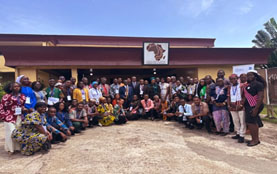

With more than three-quarters of Liberia’s population under the age of 35, Dia emphasized that the country’s prospects are inseparable from the aspirations and opportunities available to its young people.
He highlighted the alignment between youth development priorities and national frameworks, including Liberia’s ARREST Agenda and the forthcoming National Youth Policy 2025–2029, stressing that investments in education, skills development, governance, peacebuilding, and employment are critical to unlocking the country’s potential.
“Investing in young people is investing in Liberia’s future,” he said, noting that young people must be equipped not only with knowledge and skills but also with opportunities to participate meaningfully in decision-making processes.
Creating Pathways for Success
As part of that commitment, Dia highlighted UNDP’s support to youth empowerment initiatives, including the expansion of Liberia’s National Cadet Program.
The programme offers recent university graduates practical work experience, mentorship, and professional development opportunities across all 15 counties. More than 1,000 graduates are expected to benefit from the initiative this year.
He also pointed to platforms such as the National Youth Dialogue and YouthConnekt, which provide opportunities for young people to engage in national conversations, build networks, and contribute ideas to development efforts.
Dia further underscored the importance of Liberia’s National Action Plan on Youth, Peace and Security 2025–2030, describing it as a roadmap for strengthening youth participation in peacebuilding and governance.
Looking beyond Liberia’s borders, he highlighted the country’s election to the United Nations Security Council for the 2026–2027 term, describing it as a milestone that offers young Liberians an opportunity to contribute to conversations around global peace and security.
His message to the audience was distilled into three simple but powerful words:
“Remember. Reconcile. Rebuild.”
And with equal clarity, he called on both leaders and citizens to choose “service over self-interest, dialogue over division, evidence over rumor, inclusion over exclusion, and Liberia’s progress over personal ambition.”
Lessons from Liberia’s Diplomatic Journey
The summit’s guest speaker, Ambassador-at-Large Robert Y. Lormia, drew on Liberia’s diplomatic history to highlight the role of dialogue, negotiation, and strategic engagement in nation-building.
Reflecting on Liberia’s early years, he described how diplomatic efforts helped secure international recognition for Africa’s first independent republic and laid the foundation for the country’s standing in the global community.
“Constructive engagement remains essential to resolving disagreements and advancing shared interests,” Lormia told participants.
He urged young people to emulate the patience, vision, and persistence demonstrated by Liberia’s early leaders and diplomats.
At the same time, he challenged citizens to take greater ownership of national development rather than relying solely on external support.
“Liberia’s development is a responsibility we all share,” he emphasized, encouraging young people to contribute wherever they find themselves.
Leadership Begins with Integrity
Another keynote speaker, Cllr. Tiawan Saye Gongloe, focused on the values that must underpin responsible leadership: integrity, accountability, respect for human rights, and adherence to the rule of law.
He challenged participants to reject corruption and embrace fairness, inclusion, and transparency in both public and private life.
Rather than waiting for large-scale reforms, Gongloe encouraged young people to begin with practical actions in their own communities.
His message was straightforward: leadership is demonstrated not by titles but by choices, and every citizen has a role to play in building public trust and strengthening institutions.
Nurturing the Next Generation of Leaders
Opening the summit earlier, Madam Ellen Pratt-Harris, Executive Director of the Ellen Johnson Sirleaf Presidential Center for Women and Development, underscored the importance of creating spaces where young people can develop their leadership potential.
She highlighted the launch of the E Deéké youth leadership initiative, which selected a cohort of emerging women leaders from across Africa following a highly competitive application process.
The programme reflects a growing effort to expand opportunities for young women to build skills, strengthen networks, and take on leadership roles across the continent.
A Call to Action
As discussions concluded, one theme resonated throughout the day: understanding Liberia’s history is only the beginning. The real challenge lies in transforming that knowledge into action.
Whether through public service, entrepreneurship, peacebuilding, governance, or community engagement, speakers agreed that young people must play a leading role in shaping the next chapter of Liberia’s story.
The summit reaffirmed that the path to a more peaceful, inclusive, and prosperous Liberia will require informed citizens, ethical leaders, and a generation willing to learn from the past while working collectively toward the future.
For UNDP, that future depends on ensuring that young people have opportunities to succeed and a seat at the table where decisions about Liberia’s development are made.
As the summit made clear, Liberia’s greatest resource is not its history alone, but the young people who will carry its lessons forward.

Comments are closed.