

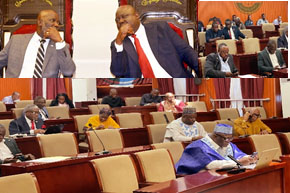

Liberia ongoing legislative leadership dispute has taken another controversial turn.
The latest has to do with claims of financial benefits, which resurfaced following reports that lawmakers seeking the removal of Speaker Richard Nagbe Koon and Deputy Speaker Thomas P. Fallah, have returned to the Capitol Building amid renewed “political maneuverings.”
An investigation conducted by In Profile Daily Newspaper alleges that lawmakers involved in the leadership dispute received US$25,000 each as a benefit to backdown.
The claims have not been independently verified, and questions remain about the source, purpose, and distribution of the funds.
The report also references US$1.8 million, raising questions about whether the amount was distributed among lawmakers, and if so, under what authority?
Without financial records, official statements, or independent confirmation, the alleged payments cannot be established as facts.
The controversy follows earlier reports that at least 47 members of 55th Legislature had signed a resolution seeking the removal of Speaker Koon and Deputy Speaker Fallah.
The effort reportedly intensified tensions in the House, raising concerns about legislative stability, and internal governance.
However, the latest account suggests that the campaign against the two legislative leaders has lost momentum, with lawmakers now returning to the Capitol Building, and the political atmosphere becoming more celebratory.
The precise circumstances behind the apparent change in political direction remain unclear.
The allegations of financial inducements have sparked questions about whether money played any role in the lawmakers’ decisions.
If the claims are substantiated, they could raise concerns about political accountability, ethical conduct, and the possible misuse of public resources.
As it is, however, there is no independently verified evidence establishing a direct connection between the payments, and the leadership dispute.
The reported developments have also renewed public debate over the responsibilities of elected representatives.
With the rigmarole, citizens continue to demand better roads, improved healthcare, quality education, and employment opportunities.
The demand placed pressure on lawmakers to demonstrate that their political decisions reflect the interests of their constituents rather than private, or partisan considerations.
Questions have additionally emerged concerning representation in Electoral District #10, and whether any lawmaker associated with the district received the US$25,000 benefit.
Those questions require clarification through reliable records, and official responses, rather than speculation.
Reports further suggest that some lawmakers attended a meeting at Ocean Drive before returning to the Capitol Building, where political tensions appeared to have subsided.
If confirmed, the sequence of events could prompt further scrutiny of the negotiations that preceded the lawmakers’ return, and whether any formal agreement was reached among the parties.
The controversy now places renewed pressure on the leadership of the House of Representatives, and relevant financial authorities to clarify whether the US$1.8 million existed; where the money originated, and whether any payments were made to individual lawmakers.
Speaker Koon, Deputy Speaker Fallah, and lawmakers associated with the removal effort should be given an opportunity to respond to the allegations.
Ultimately, the apparent cooling of the leadership dispute does not resolve the questions surrounding the alleged financial benefits.
Until documentary evidence, and credible responses are made public, claims that lawmakers abandoned their campaign, “because of cash must remain unproven allegations.”
Critics are of the opinions that legislators must demonstrate that political disagreements are resolved through constitutional procedures, and transparent negotiations, not through arrangements that undermine public confidence in democratic governance.

Comments are closed.