

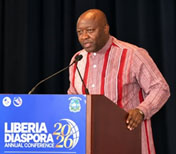

Finance and Development Planning (MFDP) Minister Augustine Kpehe Ngafuan, has called on diaspora Liberians, international investors, and development partners to view Liberia through the lens of its current transformation rather than its conflict-ridden past.
Ngafuan made the statement at the Liberian Diaspora Conference held in Washington, D.C., under the theme: “Making an Investment Case for Liberia—Betting on Liberia.”
He said, Liberia now offers a combination of sustained peace, improving institutions, abundant natural resources, and significant opportunities for first-mover investors.
Ngafuan said, Liberia’s more than two decades of peace, competitive elections, peaceful transfers of presidential power, and strengthening democratic institutions demonstrate a country steadily rebuilding its national, and international credibility.
He noted that the country current role as a non-permanent member of the United Nations Security Council represents a significant transformation from its former image as a country associated primarily with conflict.
He adds: “Liberia is no longer merely a country emerging from crisis. Liberia is a country advancing with purpose.”
Ngafuan highlighted improved macroeconomic performance, and fiscal discipline as key elements of Liberia’s investment case.
He said, the economy grew by approximately 5.1 percent in 2025, while the International Monetary Fund (IMF) projects growth of about 5.5 percent in 2026, driven particularly by mining, construction and manufacturing. Inflation, Ngafuan said, averaged approximately 4.5 percent during the first half of 2026, while the Liberian dollar remained broadly stable.
He also pointed to an IMF-projected primary fiscal surplus, excluding grants, of approximately 2.4 percent of GDP in 2026, as well as improvements in budget preparation, execution, and government payment discipline.
Ngafuan further announced that Liberia has crossed a historic US$1 billion threshold in domestic revenue collections in 2026, reaching the milestone by September 14.
He said, domestic revenue has risen from approximately US$612 million in 2023, to US$699 million in 2024, and approximately US$848 million in 2025.
He however emphasized that the milestone should not be interpreted as meaning that Liberia has sufficient resources to meet every national need. He described it as evidence of growing national capacity, and a greater ability for the country to finance its own development while meeting its obligations to citizens, contractors, employees, creditors, and development partners.
Mr. Ngafuan also outlined major infrastructure, and development initiatives under the government’s ARREST Agenda for Inclusive Development, covering Agriculture, Roads, Rule of Law, Education, Sanitation and Health, and Tourism.
He cited ongoing work on a 255-kilometer road network along the western corridor, including the St. Paul Bridge–Klay–Bo Waterside and Voinjama–Kolahun–Foya–Mendikorma corridors; construction of a new bridge across the Cavalla River linking Liberia and La Côte d’Ivoire, targeted for completion in March 2028; road equipment for all 15 counties; and ongoing investments in schools, hospitals, and other public infrastructure.
Ngafuan also highlighted progress in electricity access, the Special Agro-Industrial Processing Zone in Buchanan, and efforts to increase domestic value addition in agriculture and natural resources.
On digital and financial infrastructure, he said, Liberia is moving toward a more connected and efficient economy. He cited the Inclusive Instant Payment System, launched by the Central Bank of Liberia in December 2025, as the first phase of the National Electronic Payment Switch. During its first three months, the system processed more than 1.5 million transactions valued at over L$1.4 billion and US$9 million.
The full National Electronic Payment Switch is targeted for March 2027, and is expected to connect commercial banks, mobile-money platforms, government payment channels, and other financial institutions.
He also highlighted the 2026 Public Procurement and Concessions Act as providing an improved framework for public-private partnerships, concessions management, and electronic government procurement.
Ngafuan identified substantial investment opportunities in energy, roads, ports and logistics, housing, agro-processing, mining services and beneficiation, manufacturing, digital infrastructure, tourism, fisheries, and the blue economy.
He noted Liberia’s approximately 580-kilometer Atlantic coastline, natural resources, agricultural potential, and strategic access to the ECOWAS region, and the African Continental Free Trade Area as important elements of the country’s investment proposition.
He acknowledged challenges, including electricity costs, infrastructure gaps, limited access to finance, bureaucracy, and the need for continued improvements in regulatory predictability.
“We do not present Liberia as a country without problems, but a country increasingly capable of solving problems.”
Ngafuan meanwhile, urged Liberian diaspora to move beyond remittances for consumption toward productive investment.
He called for diaspora capital, professional expertise, international networks, and partnerships in sectors including agribusiness, logistics, housing, tourism, healthcare, education, energy and digital services.
“We ask you to examine the opportunity seriously, because Liberia is changing.”
