
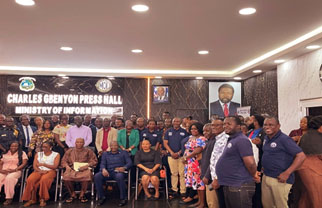

The Independent Information Commission (IIC) has commemorated the 16th anniversary of the Freedom of Information (FOI) Act of 2010.
At the ceremony, Information Commissioner Josh T. Hodges called for stronger implementation of the law, and greater public access to government information.
The Legislature enacted the FOI Act on September 16, 2010, establishing the legal right of citizens to seek, and receive information held by public institutions, and private entities performing public functions, or receiving public resources.
Former President Ellen Johnson-Sirleaf singed the law.
Hodges said, the anniversary provides an opportunity to assess progress while addressing persistent challenges to make access to information a practical right.
He described the FOI Act as a key pillar of democratic governance, transparency, and accountability, enabling citizens to monitor public resources, and participate more meaningfully in national affairs.
Hodges: “The IIC has undergone institutional renewal since 2024, despite significant operational challenges.”
The Commission, Hodges said, with support from the executive, legislature, development partners, and civil society, has launched a 2025–2030 five-year strategic plan focused on compliance, and enforcement, public awareness, policy, and legal reform, institutional strengthening, and digital transformation.
Hodges disclosed how a 2024 assessment of 103 ministries, agencies and commissions found major compliance gaps.
Only 25 institutions had appointed public information officers, while 32 had published their enabling legislation.
At the time, it was only the Ministry of Finance and Development Planning had published its budget online, and only the Ministry of Information had submitted an FOI activity report.
“Liberia’s principal FOI challenge is no longer the absence of a law. It is implementation.”
The Commissioner also disclosed that the IIC has received 18 complaints from individuals, and media organizations seeking access to public information.
Thirteen were filed by Corruption Watch against several public institutions, while The DayLight filed three involving the Environmental Protection Agency, Ministry of Mines and Energy, and Liberia Business Registry.
Hodges said, the complaints underscored the need for public institutions to appoint information officers, and establish internal review bodies.
The IIC’s 2026 public awareness survey further highlighted the challenge. Conducted in Montserrado, and Grand Bassa counties among 10,260 respondents, the survey found that 71.65 percent had never heard of the FOI Act, while 78.14 percent did not know how to submit an information request.
However, 90.71 percent agreed that access to information improves government accountability, prompting the Commission to expand education through radio, community outreach, social media, and partnerships with the media, and civil society.
Hodges said, the IIC will expand its programs beyond Monrovia, particularly in Bong, Bomi, Grand Bassa, Grand Gedeh and Nimba counties, while advancing digital systems for submitting, and tracking information requests.
He urged public institutions to comply with the FOI law, and called on journalists, civil society groups, researchers, and citizens to use the law to obtain public records, and strengthen accountability.
He said, the success of the Act should ultimately be measured by whether ordinary Liberians can obtain lawful, timely and meaningful responses to their information requests.
