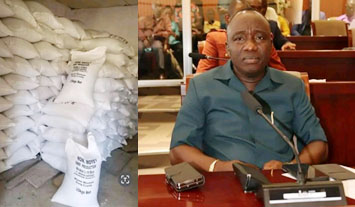
A politically sensitive controversy has erupted in Bong County following a public statement Senator Prince Kermue Moye made on Premium FM in Gbarnga.
In the statement, Moye claimed that the World Food Program (WFP) “was purchasing rice directly from his farm, and integrating it into its food distribution system.”
Sen. Moye’s remarks, which were presented as evidence of his agricultural contribution to national food supply efforts, quickly gained attention.
However, the statements have now been sharply contradicted by the international agency, triggering widespread criticism, and at the same time, raising serious questions about the accuracy of his public remarks.
In a firm clarification, WFP Liberia Country Director and Representative Agbessi Komla Amewoa, categorically denied any involvement with individual farmers in food procurement, directly disputing Moye’s so-called claim.
The Agency said, its operations are governed by strict procurement rules that prohibit direct purchases from individuals, regardless of status or political position.
Instead, WFP stated that all food supplies used in its programs in Liberia are sourced exclusively through verified farmer cooperatives.
“For its operations in Liberia, WFP procures food exclusively from farmer cooperatives. Based on our records, WFP did not procure any food from any individual farmer, including the Mr. Moye.”
The blunt denial has effectively collapsed Sen. Moye’s narrative presented during his radio appearance, placing his statements under intense public scrutiny.
Critics argue that the discrepancy raises troubling concerns about the credibility of political messaging, particularly when it involves international humanitarian organizations operating under transparent and regulated systems.
The development has also fueled broader debate about the use of public platforms to make unverified claims that may mislead citizens and distort the functioning of aid programs.
Observers say, the incident risks undermining public trust, not only in political communication, but also in the integrity of agricultural and food security narratives.
As the controversy continues to circulate, attention is now shifting toward accountability in public discourse, with growing calls for political figures to exercise greater caution and accuracy when referencing partnerships with international institutions.