At the heart of the Prosecution’s case is a letter written by former National Security Advisor to President George Weah, which they claim “admitted” the Financial Intelligence Agency (FIA) into the National Joint Security framework—allegedly forming part of a conspiracy to defraud the Government.
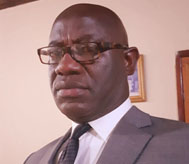
Taking the stand, Defendant Jefferson Kanmoh firmly rejected this characterization, describing the Prosecution’s interpretation as a “misinterpretation.” He emphasized that “Joint Security” has no formal legal structure and that no specific law establishes a body known as “Joint Security.”
He wondered why the Prosecution would indict him for “admitting” the FIA when that entity was already a member of the National security infrastructure of Liberia.
“ No individual, not even the President, who is Chairman of the National Security Council, can admit an entity into the National Joint Security,” the former advisor argued.
This testimony directly weakens a central pillar of the Prosecution’s case, which relied heavily on the letter as evidence of wrongdoing.
With this testimony, the Prosecution is now seemed to be left with a discarded evidence, as Cllr. Richard Scott had argued before the jury that in Liberia “ security apparatus” means “security institutions” and Kanmoh was referring to these institutions in his letter when he wrote that “ by this designation, the FIA was now part of the joint security apparatus.”
However, experts note that the definition of “apparatus” includes institutions, systems and tools, a point made by Kanmoh on the stand .
Addressing the US$6.2 million in question, Kanmoh testified that he was aware of national security funding for the elections being approved at the level of the National Security Council, with disbursements made through the Ministry of Justice in installments.
He clarified, however, that he had no knowledge of the detailed disbursement process, noting that such execution fell within the mandate of the Ministry of Finance.
His testimony corroborates earlier statements by Defendant Samuel D. Tweah Jr., who told jurors that, funds were released pursuant to approval by the National Security Council.
The security budget was not fully funded at once, but rather disbursed incrementally over times.
Kanmoh further confirmed that while he was aware of approved election-related security funding, he did not know the specifics of individual transactions, including the $6.2 million.
Minister Tweah had earlier testified that the amount formed part of the same approved national security budget, and that the funds were directed to the FIA for security purposes consistent with a mandate from the Chair of the National Security Council.
Kanmoh also testified that he received correspondence from then Acting Justice Minister- Cllr. Nyanti Tuah indicating that funds were available for Joint Security operations.
He noted that he did not recall consulting with him prior to issuing his letter.
During the jury questioning, one juror asked about his response to receiving such communication. Kanmoh replied, in a measured tone, that he “could not give a political response” now that the matter is before the court.
Another juror requested that his statement to the Liberia Anti-Corruption Commission (LACC) be read. The statement confirmed his reference to overall budget approval by the National Security Council.
A further question focused on his duties beyond assigning budget codes—highlighting growing juror skepticism toward the Prosecution’s “admission” theory.
Earlier, appearing as a subpoenaed witness, former Deputy Minister for Fiscal Affairs, Samora P.Z. Wolokollie, delivered a clear and authoritative explanation of the Minister of Finance’s powers under Liberia’s Public Financial Management framework.
The Minister is legally authorized to approve contingent allotments for well-defined emergencies where no prior appropriation exists.
A letter of request is merely an administrative step, subordinate to the Minister’s statutory authority and established regulations.
His testimony strongly reinforced the legality of the financial decisions under scrutiny.
In a notable moment, the Prosecution asked only one question on cross-examination of Dr. Wolokollie, underscoring the strength and clarity of his testimony.
The trial resumes today, May 4, 2026, with the Defense continuing the presentation of its witnesses.