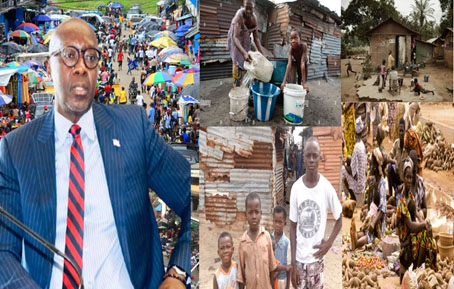
A Senator of Gbarpolu County, Amara Konneh, has sounded a stark warning about Liberia’s worsening socio-economic conditions, revealing that 52.9 percent of the population is living in multidimensional poverty.
His assertion, drawn from the 2024 Multidimensional Poverty Index, paints a troubling picture of widespread deprivation across health, education, and living standards.
Senator Konneh’s remarks have come at a time when the government is touting progress under a 21-month economic arrangement with the International Monetary Fund valued at SDR 193.8 million, approximately US$266 million.
The program is intended to strengthen macroeconomic resilience, particularly against climate shocks and global crises such as pandemics, while providing long-term concessional financing.
While acknowledging these macroeconomic gains, Konneh credited Finance Minister Augustine Ngafuan and Central Bank Governor Henry Saamoi for their efforts in stabilizing the economy.
However, he stressed that such achievements have yet to translate into meaningful relief for ordinary Liberians struggling to survive daily economic pressures.
The senator contrasted official optimism with the harsh realities on the ground, recounting his visit to the bustling Old Road Market where market women expressed frustration over rising prices.
According to them, transportation costs fueled by increased gasoline prices have triggered a surge in the cost of basic goods, especially locally produced agricultural items.
These accounts, Konneh noted, reflect a deeper crisis one that macroeconomic indicators often fail to capture.
He described an ongoing erosion of purchasing power that continues to undermine household stability, leaving many families unable to afford food, education, and healthcare.
Despite these mounting challenges, the senator criticized members of the Legislature for what he described as misplaced priorities.
Instead of focusing on economic relief measures, lawmakers have been embroiled in internal conflicts, including attempts to silence or expel colleagues over dissenting views, raising concerns about governance and accountability.
Senator Konneh also pointed to external pressures, including the ripple effects of instability in the Middle East, which he said have undermined earlier efforts by a presidential committee led by Vice President Jeremiah Koung to control commodity prices.
Senator Konneh highlighted structural weaknesses in Liberia’s economy, which remains heavily dependent on agriculture and mining sectors that are highly vulnerable and insufficient in generating employment, particularly for the country’s growing youth population.
He cited the prolonged wait for recruitment into the Armed Forces as a clear indicator of rising unemployment.
Senator Konneh called for urgent policy reforms, including the enforcement of Liberianization and local procurement laws to ensure that Liberians benefit directly from economic activities.
He criticized the dominance of foreign firms in sectors reserved for locals, arguing that stronger enforcement could stimulate domestic enterprise and retain value within the economy.
He further proposed revisiting the personal income tax system, noting that inflation has pushed many workers into higher tax brackets without corresponding increases in real income.
Adjusting the tax structure, he said, would provide immediate relief to households already stretched to the limit.
Senator Konneh urged both government officials and citizens to confront Liberia’s realities with courage and honesty.
He criticized elements within the ruling Unity Party for focusing excessively on political disputes rather than addressing the growing frustrations of ordinary people.
According to him, only a united and decisive national effort beyond reliance on international partners can reverse the country’s deepening poverty and restore hope for millions of Liberians.