“The dispute…has not only undermined social cohesion, but also threatened peace, stability, and economic development.”
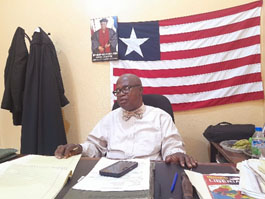
The Judge of the Sixth Judicial Circuit, Civil Law Courts, Montserrado County, J. Boima Kontoe, has called for stronger national action to tackle rising land dispute.
The dispute, Kontoe said, has not only undermined social cohesion, but also threatened peace, stability, and economic development.
During the opening of Civil Law Court ‘A’ and ‘B’ Judge Kontoe delivered the charge on Monday, September 15, 2025, at the formal opening of the September A. D. 2025 of the Civil Law Court said, resolving land conflicts.
This, he said, requires an all-inclusive approach, strengthening existing institutions, particularly probate courts, the Liberia Land Authority (LLA),
and the Center for National Documents and Records Agency (CNDRA).
Additionally, he said, reforms to current laws for the removal of archival functions from the Ministry of Foreign Affairs, the Liberia Land Authority, and the CNDRA and vest same with one agency of the government cannot be overly emphasized.
He noted that Probate Courts exercise jurisdiction over matters including the issuance of letters of administration, decrees of sale, probation and orders for the registrations of deeds and such other instruments, and the distribution of estates’ properties.
“Since many land disputes arise after these transactions, probate courts should play a central and crucial role in the prevention of such disputes.”
Kontoe: “With enhanced legal and institutional frameworks, probate courts are better positioned to mitigate land disputes. To this end, I called for the amendment of the laws to require all land-related probates to be done through an electronic database in the offices of the clerks of the probate courts. That upon the completion of a probate process, the court records in the database will be shared with the LLA, and the CNDRA.”
Furthermore, Kontoe said, probate judges should receive specialized training in land law, accessing database and estate administration to ensure that their rulings are consistent and credible.
Judge Kontoe explained that the system of land registration is still weak. Many rural communities rely on customary tenure without proper documentation, while urban areas are plagued by multiple deeds issued for the same parcel of land. “Improving the legal framework should focus on making land title registration less expensive and compulsory for all land transactions and ensuring that registered titles are conclusive proof of ownership.”
Judge Kontoe mentioned that the Land Rights Act of 2018, made significant progress by recognizing customary land, but stronger regulations are needed to integrate these rights into the formal registration system.
In addition, he suggested that digitization of land records and the introduction of a modern cadastral mapping system would greatly improve transparency.
The CNDRA serves as official custodian of public records, including land deeds and other land related titles. In principle, no land transaction was
valid unless it was recorded with CNDRA, although, this function was transferred to the LLA. Its involvement is therefore crucial; not only authenticating documents, but also maintaining a centralized archive.
The CNDRA, arguably, struggles with outdated filing systems, poor record management, and susceptibility to tampering with documents once registered.
Cases of “missing deeds registration information” or duplicate copies of the same deed are common, fueling suspicion and distrust with allegations of fraudulent registrations and issuance of certified copies of deeds.
Legal reform and institutional modernization is required to make CNDRA the sole authority for certifying the authenticity of deeds, with mandatory electronic filing to prevent alteration.
Additionally, the Agency must be digitized, with secure electronic archives of all existing documents and accessible to both the LLA and probate courts.
This interconnected system would allow judges, lawyers, and the public to instantly verify the authenticity of any deed. Moreover, strict penalties should be imposed on officials or private actors, who conspired and colluded to produce fraudulent documents.
Kontoe stated that all land sales, transfers of
titles, and inheritances should be registered with the LLA within statutory time, with penalties for non-compliance.
He said the probate courts, LLA, and
CNDRA should operate on a shared digital platform to cross-verify records and eliminate duplication and fraud.
He wants government to ensure that all lands, including public and customary ones, are properly surveyed, mapped and digitized.
This, Kontoe said, would alleviate land disputes, but called for the need to have a national dialogue with all stakeholders.